
Why Sustainability Strategies Break When They Cross Borders
Europe, Latin America, and the myth of one-size-fits-all frameworks
2/11/20262 min read
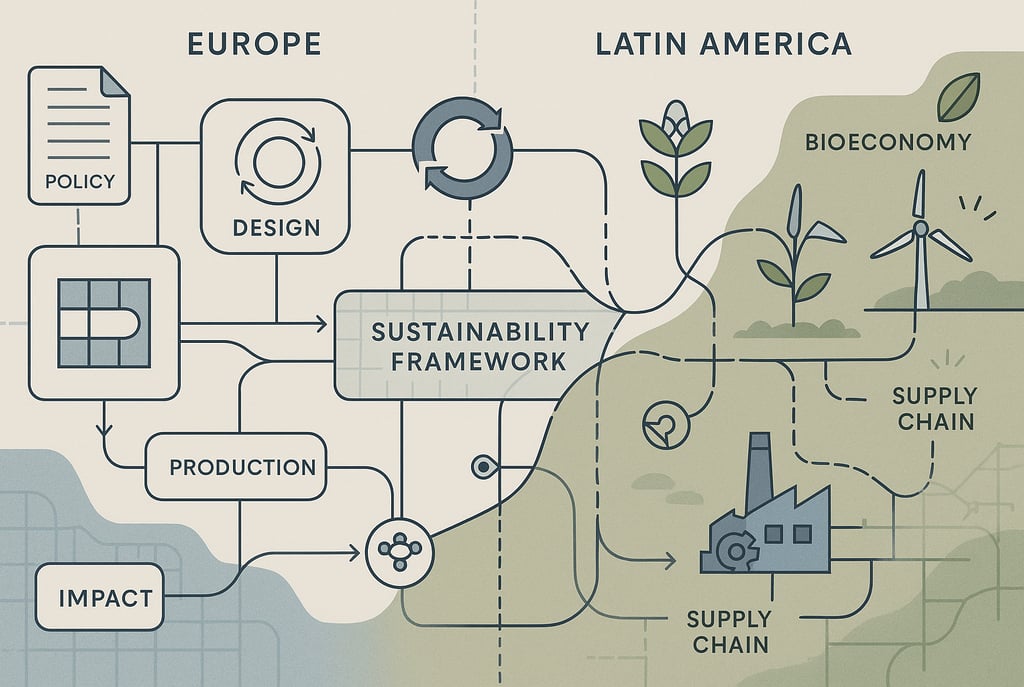
Europe, Latin America, and the myth of one-size-fits-all frameworks
Sustainability strategies are often designed as if geography were a detail.
Frameworks are developed at headquarters, aligned with global standards, and then deployed across regions with the expectation of consistency, comparability, and control.
Yet many of these strategies quietly fail — not because they are technically wrong, but because they were never designed to travel.
The Illusion of Global Uniformity
At a high level, sustainability challenges appear universal:
climate change, resource use, biodiversity loss, social equity.
But the systems that govern responses to these challenges are deeply local.
Regulation, infrastructure, institutional capacity, market maturity, and cultural norms shape what is possible — and what is not.
Ignoring these differences creates strategies that look coherent globally and collapse locally.
Europe: Structure Without Integration
Europe operates within a dense sustainability architecture:
evolving product and chemical regulation
SSbD expectations
circular economy legislation
mandatory disclosure and due diligence
The challenge in Europe is rarely lack of direction.
It is fragmentation.
Sustainability risks becoming an administrative layer — strong in reporting, weak in design and operational decisions.
Frameworks fail when they are optimized for compliance rather than integration into engineering, procurement, and investment logic.
Latin America: Potential Without Infrastructure
Latin America presents a contrasting reality:
abundant biomass and renewable potential
strategic position in global value chains
growing pressure from export markets
At the same time:
regulatory landscapes vary widely
infrastructure gaps limit implementation
institutional capacity differs by country and sector
Here, sustainability strategies fail when imported frameworks assume European-level data availability, governance maturity, or enforcement mechanisms.
Ambition without adaptation creates friction — not transformation.
Value Chains Connect What Governance Separates
Despite regional differences, value chains bind Europe and Latin America tightly together.
Design decisions made in Europe determine:
material demand
processing requirements
safety expectations
documentation and traceability burdens
Production realities in Latin America determine:
feasibility
social and environmental performance
long-term resilience
Sustainability strategies break when these interdependencies are ignored.
Frameworks Don’t Fail — Context Does
Most sustainability frameworks are internally coherent.
They fail when:
assumptions remain implicit
local constraints are treated as execution problems rather than design inputs
metrics are prioritized over feasibility
governance models assume uniform capacity
A strategy that works in Europe may need structural redesign — not minor adjustment — to function in Latin America.
Designing Sustainability Systems That Travel
Sustainability systems that survive across borders share common traits:
modular rather than rigid frameworks
decision rules instead of fixed prescriptions
life cycle thinking embedded early
SSbD used as a boundary-setting tool
governance that allows local adaptation without losing global intent
The goal is not uniform execution — but coherent variation.
From Framework Export to System Design
The next phase of sustainability leadership will not be defined by better frameworks.
It will be defined by better system design:
systems that respect regional realities while maintaining strategic integrity.
As a final reflection:
Sustainability frameworks don’t fail because they’re wrong — but because they weren’t designed to travel.
At Abaeco Consultants, this is where we focus our work: helping organizations operating across Europe and Latin America design sustainability strategies that are technically sound, context-aware, and resilient in practice — not just consistent on paper.