
Why Sustainability Is Still Treated as a Side Function — and How to Fix It
Sustainability isn’t sidelined because it lacks importance. It’s sidelined because it lacks decision authority.
3/4/20261 min read
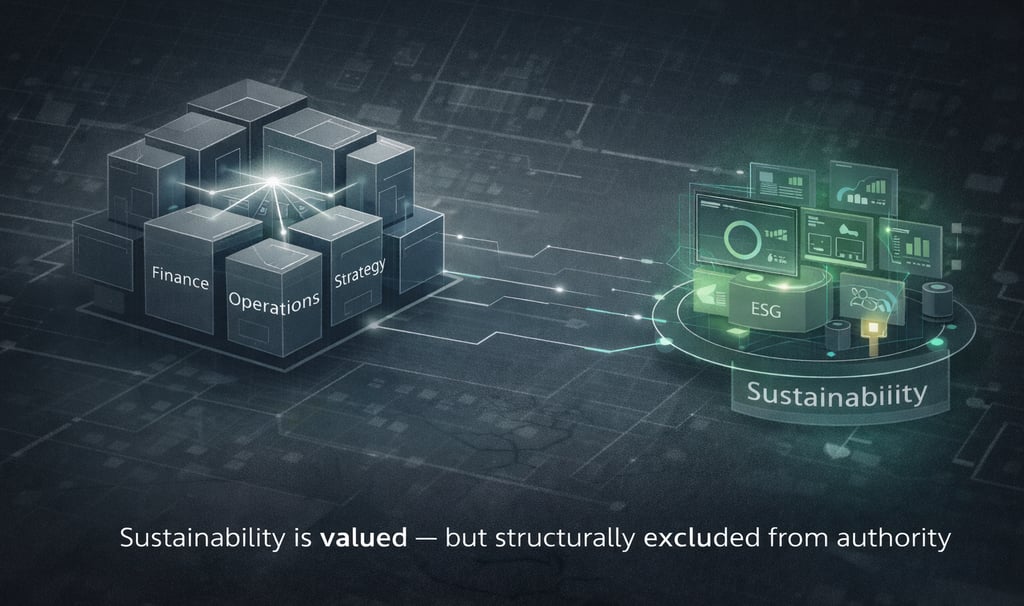
Importance is acknowledged. Authority is not.
Most organizations publicly recognize sustainability as strategic.
Few treat it as decisive.
Despite its visibility, sustainability is still positioned as:
an advisory function
a reporting unit
a coordination role
a compliance support
This is not accidental.
It is structural.
Importance Without Authority
Sustainability teams are often responsible for outcomes they cannot control:
emissions reductions without design authority
circularity targets without procurement power
Scope 3 performance without supplier leverage
When sustainability lacks authority, it becomes dependent on persuasion.
And persuasion does not survive pressure.
Why Sustainability Gets Sidelined
The organizational logic is consistent:
innovation owns speed
finance owns cost
operations own delivery
compliance owns risk
sustainability owns… influence
Influence works when incentives align.
It collapses when trade-offs appear.
The Real Issue: Decision Rights
Sustainability remains a side function because it is not trusted with decisions.
Not because it lacks competence — but because decision systems were never redesigned to include it.
This creates a paradox:
the more strategic sustainability becomes, the more frustrated sustainability teams feel.
How Organizations Fix This
Organizations that move sustainability to the core do not change rhetoric — they change architecture:
· sustainability criteria embedded into stage gates
· SSbD integrated into design authority
· escalation paths when sustainability conflicts with cost or speed
· KPIs linked to accountability, not aspiration
Sustainability stops advising — and starts deciding.
A Final Thought
Sustainability will remain “important but optional” until it is structurally empowered.
The fix is not better arguments.
It is better decision design.