Why Most Sustainability Strategies Collapse After the First Budget Cycle
Ambitious sustainability strategies are easy to announce. But the real test arrives when they compete for capital.
3/6/20263 min read
Many organizations launch sustainability strategies with strong internal support.
Workshops are held.
Targets are defined.
Roadmaps are presented.
The ambition is real. The intent is genuine.
Yet one year later, many of these strategies quietly slow down—or disappear.
The reason rarely appears in sustainability reports.
It appears in the budget cycle.
Strategies Survive Workshops — Not Budget Negotiations
In the early stages, sustainability strategies often develop in an environment designed for alignment.
Cross-functional workshops generate ideas.
Executives endorse high-level objectives.
Sustainability teams outline potential initiatives.
At this stage, conflict is minimal.
The real test comes later, when initiatives must compete for resources.
Suddenly sustainability is no longer an aspiration.
It is a line item.
And line items must compete.
They compete with:
production upgrades
digital transformation projects
cost-reduction initiatives
market expansion plans
regulatory compliance investments
When this happens, sustainability projects often lose—not because they lack value, but because they are not integrated into the organization’s investment logic.
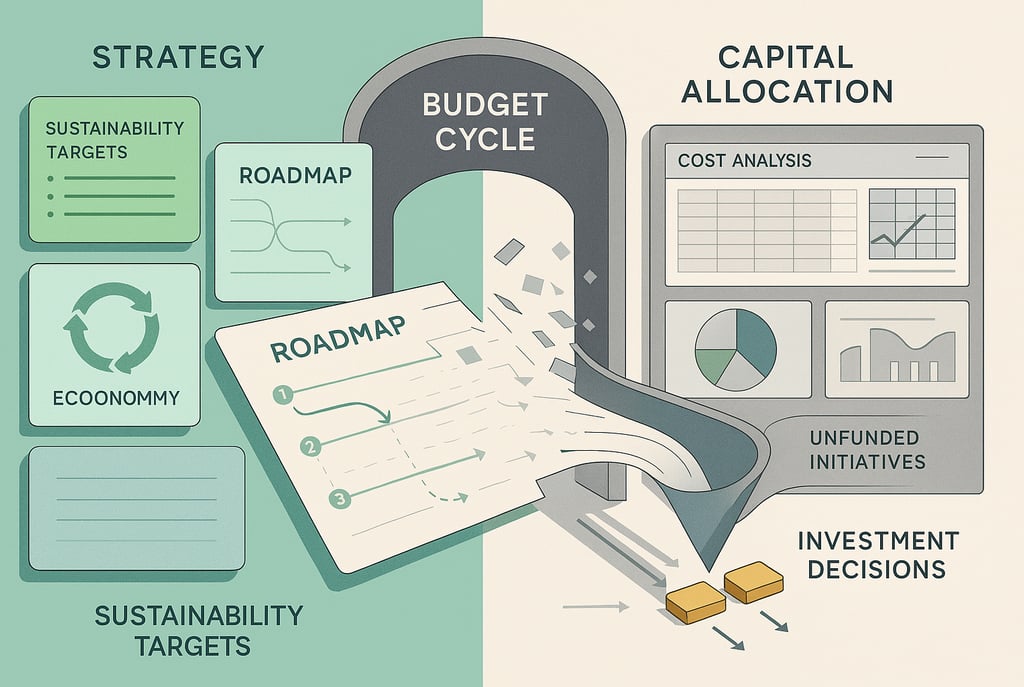
The Strategy–Budget Gap
A recurring structural gap exists in many organizations:
Sustainability strategy lives in strategic planning.
Budgets live in operational reality.
When these two systems are disconnected, sustainability initiatives struggle to survive the transition.
Common symptoms include:
projects labeled “important but not urgent”
initiatives delayed to the next fiscal year
pilots approved but scaling postponed
investments reduced to symbolic actions
The result is a familiar pattern: sustainability remains visible in strategy documents, but increasingly absent from operational decisions.
When Sustainability Competes on the Wrong Terms
Many sustainability initiatives are evaluated using the same financial criteria as short-term operational investments.
This creates structural disadvantages.
Circular economy projects may require new logistics infrastructure.
Safe and Sustainable by Design approaches may increase early development costs while reducing long-term risk.
Scope 3 reduction strategies may require collaboration across value chains rather than direct cost savings.
When evaluated only through short-term financial metrics, these initiatives struggle to justify themselves—even when they create long-term resilience and competitive advantage.
The issue is not that sustainability lacks value.
The issue is that the evaluation framework is not designed to recognize it.
The Hidden Competition Inside Capital Allocation
Every organization has an implicit hierarchy of investment priorities.
Some investments are treated as essential:
production capacity
safety improvements
regulatory compliance
core product innovation
Sustainability initiatives often exist outside this hierarchy.
They appear as additional projects rather than integrated investment criteria.
This forces sustainability leaders into an impossible position:
they must advocate for projects that compete against core operational priorities.
In these circumstances, sustainability initiatives survive only when conditions are unusually favorable.
Otherwise, they are postponed.
The Organizations That Avoid This Trap
Organizations that successfully sustain their strategies through budget cycles approach sustainability differently.
They do not treat it as a portfolio of projects.
They embed it into investment logic.
This means:
sustainability criteria are integrated into capital allocation decisions
design and procurement incorporate sustainability trade-offs by default
long-term risk and resource constraints are included in financial evaluation
decision authority is aligned with sustainability objectives
In these organizations, sustainability does not compete with core investments.
It shapes how investments are evaluated.
This is a structural difference.
And it determines whether sustainability strategies survive contact with financial reality.
Circularity and SSbD Require Investment Discipline
Circular economy initiatives, for example, rarely succeed through isolated projects.
They often require:
reverse logistics infrastructure
material recovery systems
design changes enabling disassembly and reuse
Similarly, Safe and Sustainable by Design (SSbD) demands early investments in design capabilities, material evaluation, and lifecycle thinking.
These are not marginal adjustments.
They are system investments.
Without alignment between strategy and capital allocation, these investments struggle to gain approval—no matter how strong the sustainability narrative may be.
The Budget Cycle Reveals Strategic Commitment
Workshops test alignment.
Budgets test commitment.
If sustainability disappears during capital allocation, it reveals something important:
the organization has not yet integrated sustainability into its economic logic.
This does not mean leaders lack ambition.
It means the systems that govern investment decisions remain unchanged.
Until those systems evolve, sustainability will continue to struggle at the moment that matters most.
A Final Thought
A sustainability strategy that cannot survive budgeting was never a strategy.
It was a presentation.
Real sustainability strategies are not defined by targets or roadmaps.
They are defined by the investment decisions organizations are willing to make when resources are limited and priorities compete.
At Abaeco Consultants, we help organizations align sustainability ambition with investment logic—ensuring that circularity, Safe and Sustainable by Design, and long-term resilience are embedded in the decisions that shape the future of the business.
Because sustainability does not fail when strategies are written.
It fails when budgets are decided.