
Why Most Companies Underestimate the Complexity of Circular Supply Chains
Circular supply chains promise efficiency, resilience, and sustainability. But they operate under fundamentally different rules than the linear systems most companies understand.
3/18/20262 min read
The Illusion of “Just Reverse the Flow”
Many organizations exploring the circular economy assume the transition is conceptually simple:
if materials flow from suppliers to customers in a linear supply chain, circularity simply means bringing those materials back.
This assumption is appealing.
It is also incorrect.
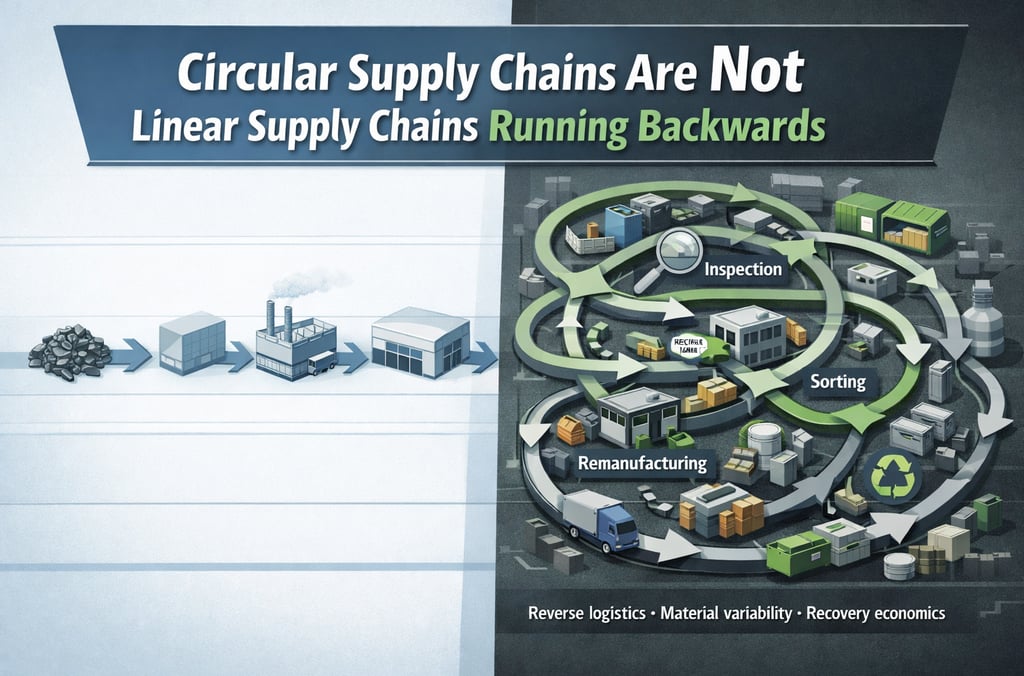
Circular supply chains are not linear supply chains running backwards.
They involve new uncertainties, new operational requirements, and fundamentally different economics.
Companies that underestimate this complexity often discover that circular initiatives stall once they move from strategy presentations to operational reality.
Linear Supply Chains Are Built for Predictability
Traditional supply chains are designed around controlled inputs and predictable outputs.
Companies typically know:
what materials they will receive
when those materials will arrive
the quality specifications of those materials
the processes required to transform them
The system flows in one direction: supplier → manufacturer → distributor → customer.
Optimization focuses on cost, speed, and reliability.
Circular supply chains introduce entirely different conditions.
Circular Systems Must Manage Uncertainty
In circular systems, the material stream becomes less predictable and more variable.
Products returning into the system may differ in:
condition
contamination levels
composition
remaining functional life
A recycling or remanufacturing facility rarely receives inputs as standardized as those in virgin material supply chains.
Instead, organizations must manage heterogeneous material streams that require sorting, inspection, and sometimes redesign of processes.
This variability significantly increases operational complexity.
Reverse Logistics Is Not a Minor Adjustment
One of the largest hidden challenges in circular supply chains is reverse logistics.
Collecting products after use requires infrastructure that most organizations have never built:
return systems
collection points
sorting facilities
transportation for dispersed product streams
Unlike forward logistics, which benefits from large consolidated shipments, reverse flows are often fragmented and geographically dispersed.
This makes them more expensive and operationally difficult.
Quality Variability Changes Manufacturing
In circular systems, inputs are rarely uniform.
This creates challenges across manufacturing operations:
remanufacturing lines must adapt to variable product conditions
recycling processes must deal with mixed materials
contamination can disrupt recovery efficiency
Engineering teams often need to design flexible processes capable of handling variability.
Without this capability, circular systems become economically fragile.
The Economics Are Not Automatically Favorable
Many circular strategies assume that recovering materials will naturally create value.
In practice, economic viability depends on multiple factors:
collection costs
sorting efficiency
material purity
market demand for secondary materials
If recovery costs exceed the value of recovered materials, circular systems struggle to scale.
This is why design decisions upstream play such a critical role in circular supply chain success.
Design Determines Supply Chain Complexity
The complexity of circular supply chains is often locked in during product design.
Products that are difficult to disassemble, contain incompatible materials, or degrade during use create major challenges for recovery systems.
Conversely, products designed for:
modularity
material compatibility
ease of separation
enable more efficient circular supply chains.
In other words, circular supply chains do not begin in logistics.
They begin in engineering and design decisions.
Circular Systems Require New Capabilities
Organizations building circular supply chains must develop capabilities beyond traditional supply chain management, including:
reverse logistics design
material flow analysis
product recovery systems
cross-functional coordination between design, manufacturing, and supply chain teams
These capabilities rarely exist in conventional operational structures.
As a result, circular supply chains require organizational transformation, not just incremental improvement.
A Final Thought
Circular supply chains promise powerful sustainability and resilience benefits.
But they are structurally different systems, not minor adjustments to existing ones.
Companies that recognize this complexity early can design products, processes, and logistics networks that make circularity viable.
Those that do not often discover the challenge only after implementation begins.
And by then, the system is much harder to redesign.
Circular supply chains are not linear supply chains running backwards.
They are entirely new systems that must be engineered from the ground up.