
When Sustainability Becomes Infrastructure: Designing Systems That Survive Policy Cycles
Sustainability only delivers value when it is designed to last. Why resilient systems outperform short-lived initiatives.
1/28/20263 min read
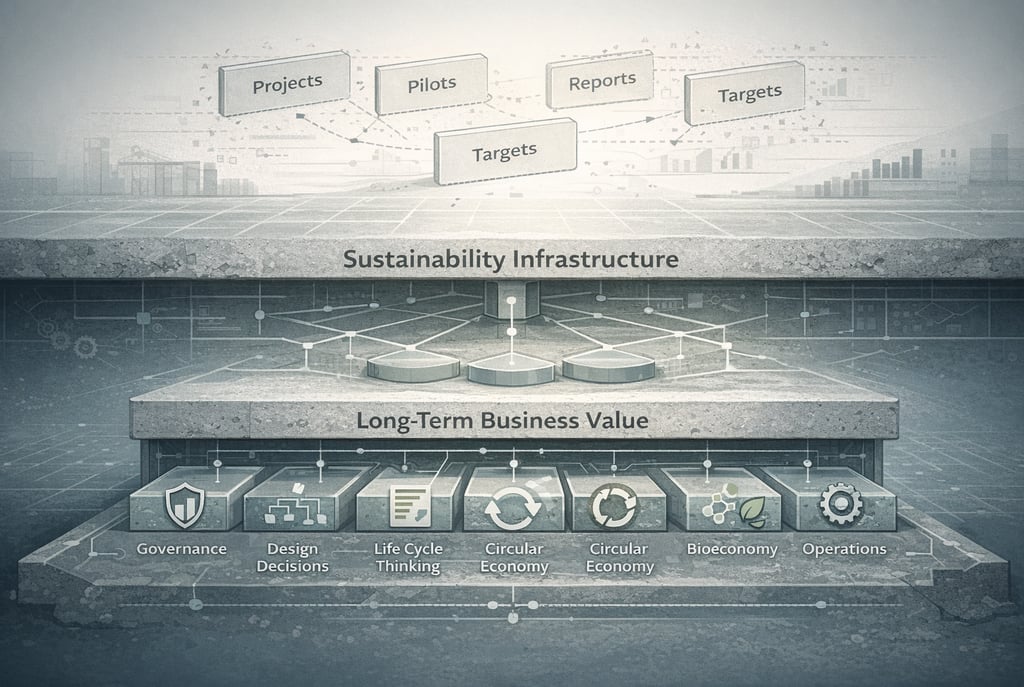
Sustainability strategies often fail not because they are wrong, but because they are too fragile.
They depend on short-term incentives, individual champions, or political cycles. When priorities shift, budgets tighten, or leadership changes, sustainability initiatives are quietly deprioritized—despite strong technical foundations.
The organizations that succeed take a different approach:
they design sustainability as infrastructure, not as a program.
From Projects to Systems
In both Europe and Latin America, sustainability efforts are frequently implemented as isolated projects:
a circular pilot
a bio-based demonstration
a reporting upgrade ahead of regulation
a short-term innovation grant
These initiatives can be valuable, but without system-level integration they rarely scale.
Infrastructure thinking changes the question from “Does this project work?” to “Can this survive real-world constraints?”
That shift forces organizations to address:
governance and ownership over time
interfaces between sustainability, operations, and finance
regulatory durability across jurisdictions
design choices that lock in—or limit—future options
Why Europe and Latin America Face Different (but Connected) Challenges
Europe operates in a highly structured regulatory environment:
evolving circular economy legislation
product sustainability requirements
chemical safety and SSbD expectations
mandatory disclosure and due diligence
The challenge is not direction, but integration—ensuring sustainability does not become an administrative layer detached from engineering and design decisions.
Latin America, by contrast, often faces:
regulatory asymmetry between countries
strong resource and bioeconomy potential
infrastructure and investment constraints
pressure from export markets and European standards
Here, sustainability fails when frameworks are imported without adaptation to local realities, supply chains, and institutional capacity.
Organizations operating across both regions need sustainability systems that are robust, adaptable, and context-aware.
Safe and Sustainable by Design as Structural Reinforcement
SSbD is often misunderstood as a compliance concept. In practice, it functions as structural reinforcement for innovation systems.
When applied early, SSbD:
forces clarity on intended function and value creation
reduces downstream redesign driven by safety or environmental concerns
aligns R&D, regulatory, and commercial priorities
creates traceable decision logic that survives audits and leadership changes
This is particularly critical in bioeconomy applications, where technical uncertainty, safety considerations, and scale-up risks intersect.
Circularity Without Infrastructure Is Fragile
Circularity initiatives often collapse under operational pressure.
Common reasons include:
reverse logistics that are not economically viable
materials chosen without end-of-life pathways
circular KPIs that conflict with procurement incentives
pilots that cannot be replicated across sites or markets
Circular systems only endure when they are designed as part of the operating model—embedded in procurement, product architecture, supplier relationships, and performance measurement.
This is where life cycle thinking moves from analysis to system design.
Life Cycle Thinking as a Design Tool, Not a Report
In mature organizations, life cycle approaches are no longer limited to LCA reports.
They are used to:
identify structural risk hotspots in value chains
guide early design trade-offs under uncertainty
prioritize interventions with long-term leverage
align environmental performance with economic resilience
Used this way, life cycle thinking becomes a navigation tool, not a retrospective justification.
Designing for Longevity
Sustainability that lasts shares common characteristics:
decisions are documented, not implicit
trade-offs are explicit and revisitable
responsibilities are distributed, not person-dependent
systems can absorb regulatory and market change
This is not about predicting the future perfectly—it is about designing for adaptability.
The Consultant’s Role Has Changed
In this context, consulting is no longer about delivering frameworks or reports.
The real value lies in:
helping organizations make defensible decisions under uncertainty
translating sustainability ambition into design criteria and governance
aligning circularity, bioeconomy, and SSbD into coherent systems
reducing long-term risk while enabling innovation
At Abaeco Consultants, this is the work we focus on—supporting organizations in Europe and Latin America to build sustainability systems that are technically sound, operationally realistic, and resilient to change.
A Closing Thought
The next phase of sustainability will not be led by the most ambitious targets, but by the most durable designs.
Sustainability succeeds when it becomes part of the infrastructure—quiet, robust, and difficult to remove.
If your organization is navigating sustainability across regions, regulatory regimes, or complex value chains, we invite you to a free consultation to explore how design-led sustainability can support long-term resilience.
Because the systems that last are the ones designed for reality.