What’s Coming in Sustainability, Circularity & SSbD Policy (US, EU & Latin America)
A global outlook on how sustainability, circular economy, and Safe-and-Sustainable-by-Design policies are evolving across the EU, the US, and Latin America. What decision-makers and engineers need to prepare for as 2026 approaches.
12/30/20254 min read
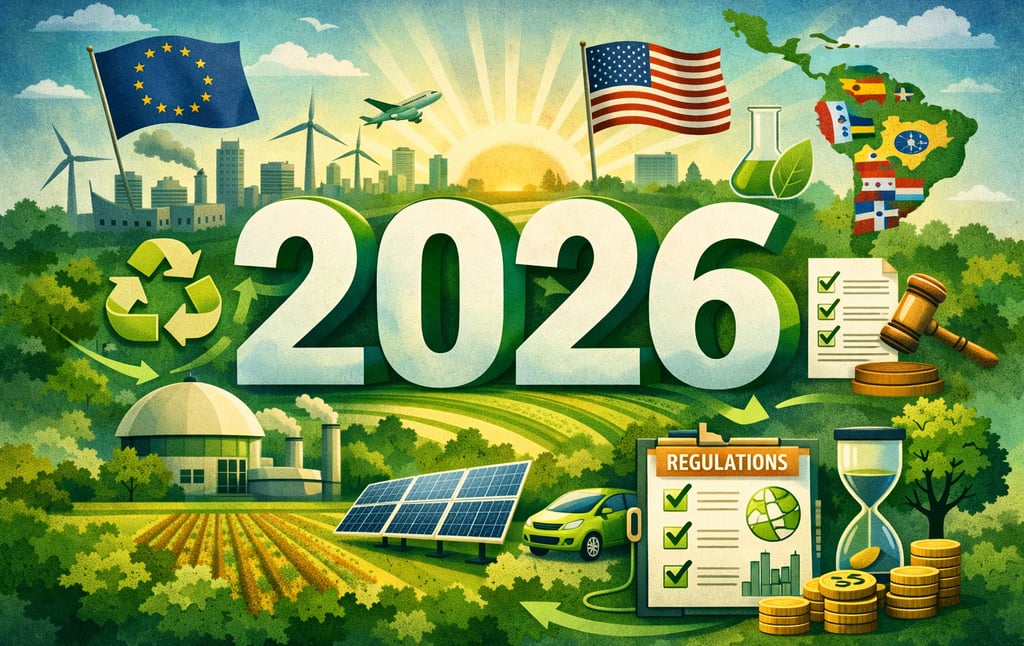
As regulatory pressure and societal expectations rise, governments are advancing new policy frameworks and governance mechanisms to drive sustainable, circular, and innovative industrial systems. The upcoming years — especially late 2025 through 2026 — will shape how companies design, invest, and scale solutions in these areas.
🇪🇺 European Union: Systemic Shifts Toward Circularity, SSbD & Mandatory Due Diligence
1. A New Circular Economy Act (2026)
The EU is advancing a Circular Economy Act expected for adoption in 2026, designed to:
Establish a Single Market for secondary raw materials
Boost high-quality recycled material supply
Stimulate demand for recycled content in products
This initiative builds on the EU’s ongoing Circular Economy Action Plan and aims to transform product flows at the macro scale rather than only at individual sectors. Environment
What it means: industrial designs, procurement rules, and supply chains will need to account for circular inputs and outputs — creating opportunities for system-level feasibility studies and engineering-guided redesigns.
2. Mainstreaming Safe & Sustainable-by-Design (SSbD)
The EU’s SSbD framework — part of the broader Chemicals Strategy for Sustainability — is being refined with a revised Commission Recommendation due by end of 2025. This includes:
Clearer criteria and assessment methods
Tools and case studies to help industry apply SSbD principles
Guidance for lifecycle-level evaluation of chemicals, materials, and products
Stakeholders across industry, research institutions and member states are contributing feedback through testing rounds and consultations. Research and innovation
What this means for practice: SSbD is evolving from a conceptual strategy into a practical regulatory reference, particularly for companies developing materials, chemicals, and circular products. Designers and engineers will increasingly need to integrate SSbD early in R&D to align with evolving EU governance.
3. Corporate Sustainability Due Diligence Directive (CSDDD)
The CSDDD, adopted in 2024, requires companies above certain turnover thresholds to conduct due diligence on human rights and environmental impacts throughout their value chains. Implementation across member states will take place through 2027 and 2028. Wikipedia
Why it matters: This is a game-changer for governance, as companies — including non-EU firms with EU turnover — must identify and manage impacts well beyond emissions: biodiversity, waste, water use, supply risk and more.
4. Sustainability Reporting & Integrated Compliance Frameworks
EU regulators are consolidating sustainability obligations (e.g., Corporate Sustainability Reporting Directive — CSRD), EU Taxonomy, and CSDDD into more consistent frameworks that will shape corporate disclosures and operational governance for years to come. Council Fire
Takeaway: Sustainability compliance is shifting from voluntary disclosure to obligatory governance structures with legal penalties.
🇺🇸 United States: Federal Slower But States Moving Fast
1. Fragmented Federal Policy, Fragmented Market
At the federal level, momentum on national sustainability laws is mixed. While past initiatives like the Inflation Reduction Act (IRA) still underpin climate investments and advanced energy strategies, federal regulatory action has slowed due to political shifts and gridlock. Center for Sustainbability & Excellence
For companies: national alignment on sustainability and circular economy policy is uncertain, but frameworks for engineering-led low-carbon solutions and industrial decarbonization continue to be relevant for federal funding and compliance discussions.
2. State-Level Circular Economy & EPR Regulations
Much of the U.S. circularity progress is happening via state laws, particularly around Extended Producer Responsibility (EPR) for packaging and waste — where producers bear end-of-life responsibility for products and packaging in several states. These laws:
Require producer responsibility organizations (PROs)
Introduce fee structures tied to design choices
EPR is emerging as a default approach to circular accountability in the U.S. market. DLA Piper
Implication: Multi-state compliance strategies are necessary for manufacturers, especially in packaging and consumer goods.
3. Sustainability Governance Beyond Climate
In the U.S., corporate sustainability governance now often requires aligning:
State incentives for clean energy and low-emission technologies
Public and investor expectations for sustainability claims
Cross-sector governance to manage environmental risk
This patchwork means companies need internal governance and engineering expertise to anticipate and meet diverse requirements.
Latin America: Regional Cooperation & Governance Building
Latin American sustainability and circular policy is gaining institutional momentum, even if formal regulation is still emerging.
1. Coalitions & Regional Governance Platforms
Latin America recently launched the Coalition for Circular Economy, an initiative focused on:
Collaborative policy design
Cross-government capacity building
Private-public innovation partnerships
This coalition seeks to implement shared approaches to sustainable production and consumption across the region. UNEP - UN Environment Programme
Why this matters: Regional consensus mechanisms are forming that will influence national policy trajectories and create shared governance standards.
2. Public Policy Dialogues & Technical Frameworks
Regional bodies like CEPAL (ECLAC) and SELA are hosting dialogues on circular economy, measurements, and governance frameworks — with events and seminars to strengthen institutional capacity. SELA
These efforts are building the foundation for:
Future national frameworks
Common indicators for circular policy
Integrated measurement systems
3. Sustainable Resource Governance & Investment Initiatives
Joint initiatives between the EU and Inter-American Development Bank (BID) are supporting sustainable mining practices and governance of critical raw materials in Latin America. These projects align sustainability with economic investment strategies. Servicio Europeo de Acción Exterior
Practical impact: Latin America is strengthening governance where sustainability converges with economic and industrial policy — especially in materials essential for renewable energy and circular manufacturing.
Key Trends Shaping the Next 3–5 Years
Governance Goes Upstream
Policymakers are moving beyond voluntary sustainability efforts toward mandatory governance structures, due diligence requirements, and extended producer responsibility regimes.
SSbD Becomes a Practical Tool
The SSbD Framework in the EU is transitioning from high-level guidance to something businesses must use to align early designs with future market access. Research and innovation
Circular Economy Policy Diffuses Globally
From EU legislative acts to U.S. state EPR laws and Latin American coalitions, circular economy governance is being institutionalized in multiple ways.
Regional Approaches Will Matter
Latin America’s coalition efforts, EU’s integrated frameworks, and the U.S. state-led governance mosaic all indicate that multi-jurisdiction strategies will be the norm for global businesses.
What This Means for Practitioners
For consultants, engineers, and businesses:
Understand regional specifics (EU directives vs U.S. state laws vs Latin American governance dialogues).
Invest in early compliance strategies like SSbD and lifecycle assessments.
Anticipate governance risks tied to due diligence, circularity, and product design obligations.
Link policy insight with engineering solutions to help clients unlock value from compliance requirements.
This policy landscape is rapidly evolving — and those who build policy-aware engineering and sustainability strategies will lead the next wave of sustainable industrial transformation.