Top Sustainability Tools Every Company Should Use in 2026: A Guide to Smarter, Circular, Science-Based Growth
Discover the essential tools every company needs to drive circularity and science-based sustainability. Turn data into action—and sustainability into real business value.
12/11/20252 min read
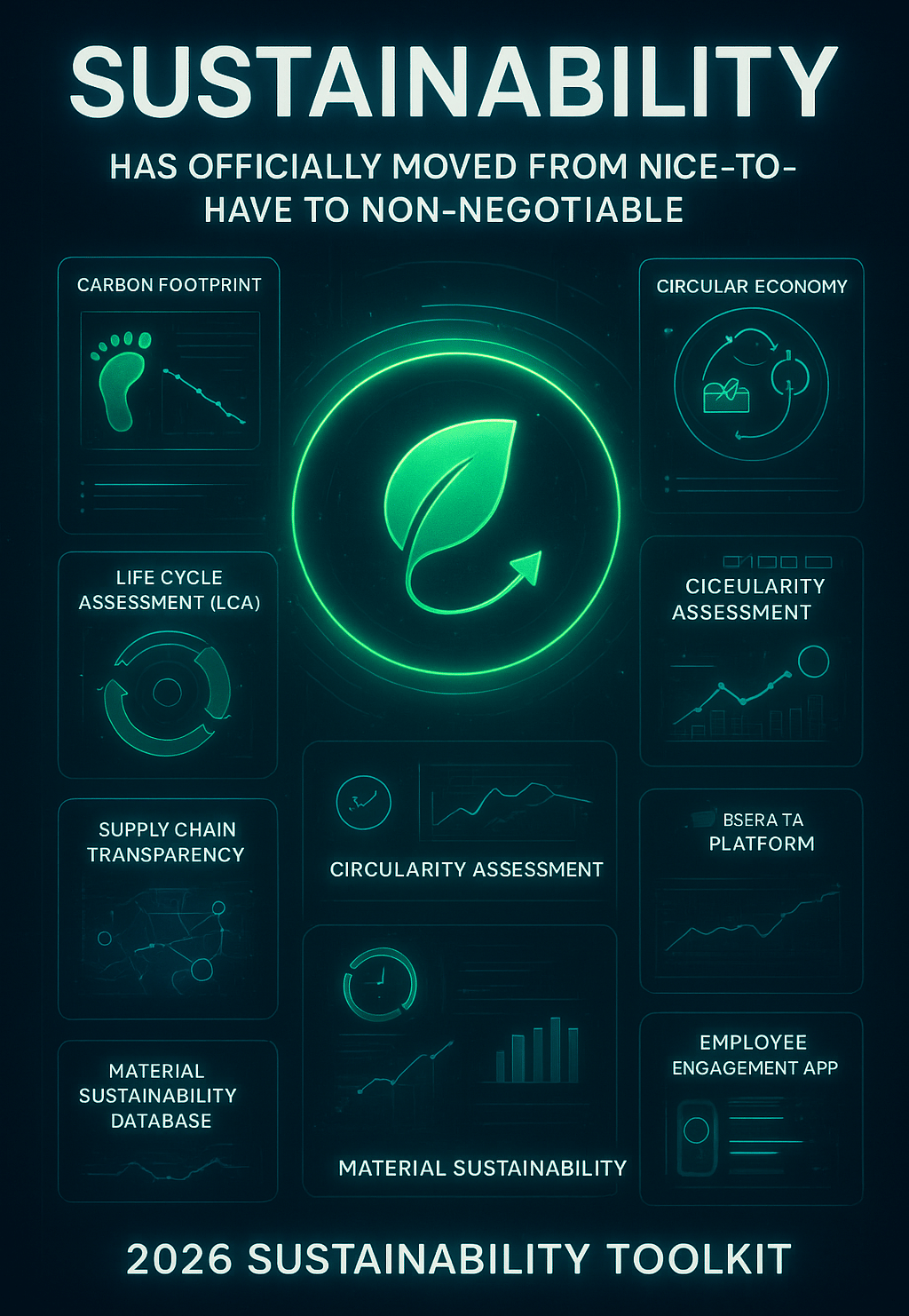
Sustainability has officially moved from nice-to-have to non-negotiable. Whether driven by regulation, investor pressure, or customer demand, companies are now expected not only to measure their impact but also to show tangible progress.
But here’s the challenge: most organizations know why sustainability matters—they just struggle with how to operationalize it.
That’s where the right sustainability tools make all the difference.
Below is a curated list of tools that help companies accelerate their sustainability journey, improve reporting accuracy, and unlock new opportunities through circularity and science-based strategy.
1. Life Cycle Assessment (LCA) Tools
LCA tools help companies understand the environmental impact of products across their full life cycle—from raw materials to disposal. This is the backbone of circular innovation.
Popular platforms:
SimaPro – robust modeling, ideal for complex products
GaBi / Sphera – highly detailed databases and scenario modeling
OpenLCA – open-source option for teams starting out
Why it matters:
Companies can identify hotspots, evaluate circular design options, compare materials, and quantify emission reductions based on real data—not assumptions.
2. Carbon Accounting & Science-Based Target (SBTi) Tools
Carbon accounting is now essential for science-based decision-making and SBTi alignment. Good tools simplify data collection and automate complex calculations.
Leading tools:
Watershed
Persefoni
Normative
Plan A
What they help with:
Automated emissions mapping
Scope 1, 2, and increasingly Scope 3 calculations
SBTi pathway modeling
Reporting for CSRD, SEC, CDP, and GHG Protocol
These tools ensure companies don’t just claim reductions—they validate them.
3. Circularity Assessment & Material Flow Tools
Circularity is no longer only about recycling—it’s about keeping materials and value in the system as long as possible.
Useful platforms:
Circularity Indicators (Ellen MacArthur Foundation)
Material Circularity Indicator (MCI) tools
Circle Economy’s Circle Assessment
Metabolic’s resource flow tools
Why they matter:
They help companies pinpoint where resources are leaking, where loops can be closed, and what business models (rental, repair, remanufacturing) make sense.
4. Supply Chain Transparency & ESG Data Platforms
A company can’t be more sustainable than the supply chain behind it.
Top solutions:
EcoVadis – supplier scoring and benchmarking
Worldfavor – sustainability data exchange
IntegrityNext – automated supplier screening
Sedex – ethical and social compliance
These tools help companies assess supplier risks, ensure ethical sourcing, and track real ESG performance.
5. Material & Product Sustainability Databases
For companies working with product development, packaging, or procurement, material databases are essential.
Notable tools:
Matmatch, Granta MI, Higg MSI
Circular materials marketplaces like Rheaply or Loopcycle
These tools support companies in choosing low-impact, circular, recyclable, or renewable materials.
6. Sustainability Reporting & Compliance Platforms
With CSRD, ESRS, and other regulations strengthening worldwide, compliance tools have become indispensable.
Reporting software options:
Position Green
Central Sustainability Hub (CSH)
Enablon
Workiva (especially strong for CSRD)
Key value:
They streamline data collection, automate audit trails, and simplify regulatory compliance—saving companies time, cost, and headaches.
7. Engagement & Behavior-Change Tools
Sustainability only works when people participate.
Useful tools:
Sustainability gamification apps (e.g., Pawprint)
Internal engagement platforms (e.g., Culture Amp, WeSpire)
Employee carbon footprint apps
These make sustainability part of daily routines, not just annual reports.
How These Tools Support SSBD and Circular Strategies
Your consulting firm’s focus on science-based sustainable business development (SSBD) and circularity is a perfect match for these tools because they allow clients to:
Base decisions on verified data, not guesswork
Model circular business opportunities
Compare scenarios and quantify ROI
Identify the best pathways for meeting SBTi or CSRD requirements
Build resilient, transparent supply chains
Reduce waste and unlock new value streams
Communicate sustainability progress credibly
Tools don’t replace strategy—but they do accelerate it.
Final Thoughts
As sustainability moves deeper into the core of business strategy, companies that adopt robust tools will not only reduce risk—they’ll also gain competitive advantage.
Our role as consultants is to translate these tools into actionable insights, business value, and circular opportunities tailored to each clients needs.