The Sustainability Skills Gap No One Is Training For
The missing capability isn’t analytics or reporting. It’s the ability to make decisions under uncertainty, pressure, and constraint
3/2/20262 min read
The Missing Skill Is Not Reporting — It’s Judgment
Over the past decade, sustainability capability building has focused heavily on tools and frameworks.
Training programs emphasize:
ESG standards and disclosure requirements
Data collection and management systems
Carbon accounting and life cycle assessment tools
Regulatory updates and reporting cycles
These skills matter. Organizations need them to operate in today’s regulatory and stakeholder environment.
But they are not the limiting factor anymore.
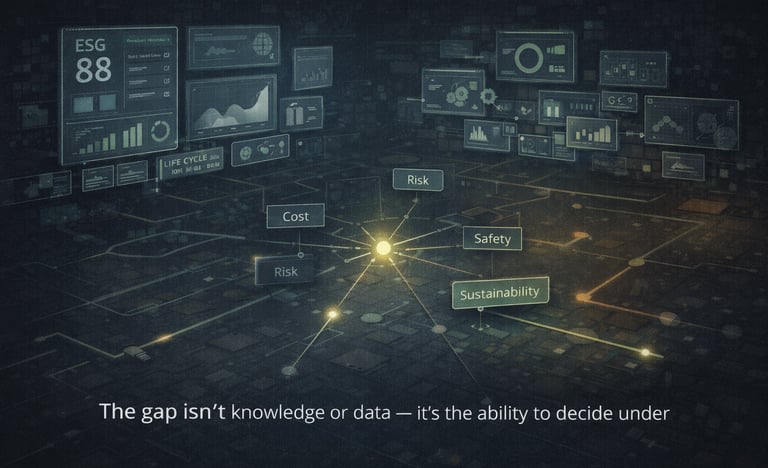
Most organizations do not struggle because they lack data, dashboards, or frameworks.
They struggle because they do not know how to act when sustainability data collides with real business constraints.
The Real Skill Gap
The most critical sustainability skill is rarely named—and almost never trained:
Decision-making under constraints.
This includes the ability to:
Navigate uncertainty without waiting for perfect data
Resolve trade-offs between sustainability, cost, risk, and speed
Act early, when decisions matter most and information is incomplete
Defend sustainability-driven choices in operational and financial forums
These are not technical skills.
They are judgment skills.
And they are the skills that determine whether sustainability shapes outcomes—or remains advisory.
Why This Gap Persists
Most organizations assume decision-making is something people “learn on the job.”
That assumption is especially damaging in sustainability.
Sustainability decisions are structurally different from many traditional business decisions:
Long time horizons where consequences unfold years later
Diffuse accountability across functions and value chains
Cross-functional impact involving design, procurement, compliance, finance, and operations
Irreversibility, where early choices lock in environmental and regulatory exposure
Without structured training, people default to what feels safest:
postponing decisions
escalating without resolution
hiding behind data requests
treating sustainability as a justification exercise rather than a choice
This is not incompetence.
It is a predictable response to untrained decision complexity.
Why More Data Does Not Close the Gap
Organizations often try to compensate for weak decision capability with more analysis:
more scenarios
more indicators
more detailed assessments
But data does not substitute for judgment.
In fact, without decision discipline, more data often increases hesitation.
People feel informed—but not confident.
This is why many sustainability professionals become excellent analysts but reluctant decision influencers. They are trained to produce insight, not to convert insight into action under pressure.
What the Next Sustainability Leader Actually Needs
The next generation of sustainability leaders will not stand out because they report better.
They will stand out because they can:
Translate analysis into clear choices
Frame sustainability trade-offs in business language
Challenge assumptions without becoming adversarial
Operate across innovation, compliance, finance, and operations
Design decision processes—not just metrics and dashboards
They will understand that sustainability leadership is less about expertise—and more about decision architecture.
Training for the Skill That Matters
Closing the sustainability skills gap does not require more frameworks.
It requires intentional development of:
trade-off reasoning
escalation and governance design
early-stage decision filters (such as life cycle thinking and SSbD)
confidence to act under uncertainty
These skills must be practiced, coached, and reinforced—just like financial or operational decision-making.
A Final Thought
The future sustainability leader is not a better reporter.
They are a better decision-maker.
Until organizations train for judgment—rather than just compliance—sustainability capability will remain fragile, no matter how advanced the data becomes.
And the most important sustainability skill will remain the one no one is formally teaching.