
The Hidden Cost of Sustainability Pilots No One Talks About
When pilots stall, they don’t just waste resources — they reshape behavior. Over time, failure trains organizations to stop believing sustainability can scale.
2/20/20262 min read
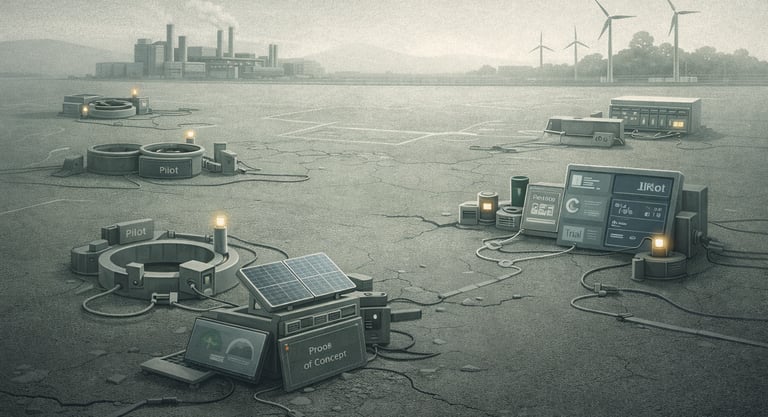

Why pilots don’t just fail technically — they erode organizational confidence
Sustainability pilots are everywhere.
Circular pilots. Bio-based pilots. Low-carbon pilots. Digital ESG pilots.
They are announced enthusiastically, funded cautiously, and evaluated optimistically.
And then many of them quietly stop.
When pilots fail, organizations usually treat it as a technical issue:
the technology wasn’t mature, the business case wasn’t ready, the timing wasn’t right.
But the real cost of failed sustainability pilots is rarely measured — and far more damaging.
Pilot Success ≠ Scalability
Most sustainability pilots are designed to prove technical feasibility, not organizational scalability.
They answer questions like:
· Can this material work?
· Can this process run?
· Can this concept reduce impact under controlled conditions?
They rarely answer:
· Who owns this once it leaves the pilot?
· Which function absorbs added cost or complexity?
· How does this compete with existing KPIs and incentives?
· What happens when conditions are no longer “ideal”?
As a result, many pilots succeed technically — and fail organizationally.
The Accumulation of Learning Debt
Every stalled pilot leaves behind something invisible but powerful: learning debt.
Teams learn that:
· sustainability initiatives are temporary
· pilots are optional
· long-term value is negotiable
· “we’ll revisit this later” is an acceptable outcome
Over time, organizations become cautious — not because sustainability is hard, but because experience has trained them to expect disappointment.
This is how innovation fatigue sets in.
Innovation Fatigue Is a Systemic Risk
After enough stalled pilots:
· engineers disengage
· operations resist disruption
· managers deprioritize sustainability topics
· leadership grows skeptical of “the next pilot”
Sustainability loses credibility — not because it failed once, but because it failed repeatedly without resolution.
The organization becomes technically capable — and culturally resistant.
Pilots Fail When Governance Is Missing
Pilots rarely fail because of bad ideas.
They fail because no one answers structural questions early:
· Who decides if this scales?
· Who funds the transition phase?
· Which KPIs change if this succeeds?
· What trade-offs are acceptable?
Without governance, pilots are experiments without a future.
Designing Pilots That Build Confidence
Organizations that use pilots effectively do three things differently:
· define ownership beyond the pilot phase
· link pilots to decision gates, not just reports
· treat pilots as learning investments, not proof exercises
Pilots should not ask: “Does this work?”
They should ask: “Are we willing to decide based on what we learn?”
A Final Thought
Every failed pilot trains the organization — just not in the way leaders intend.
The question is not how many pilots you run.
It is whether your organization learns to decide from them.