The Four Stages of Life Cycle Assessment — And Why Each One Matters
Understanding the four stages of Life Cycle Assessment is essential for producing reliable environmental insights. From defining the right question to interpreting the results, each step shapes how sustainability decisions are made.
3/20/20264 min read
Life Cycle Assessment (LCA) is one of the most powerful tools for understanding environmental impacts.
But its value depends on how carefully each stage of the assessment is carried out.
When done properly, LCA provides insight into how materials, processes, and systems affect the environment across their entire life cycle—from raw material extraction to final disposal.
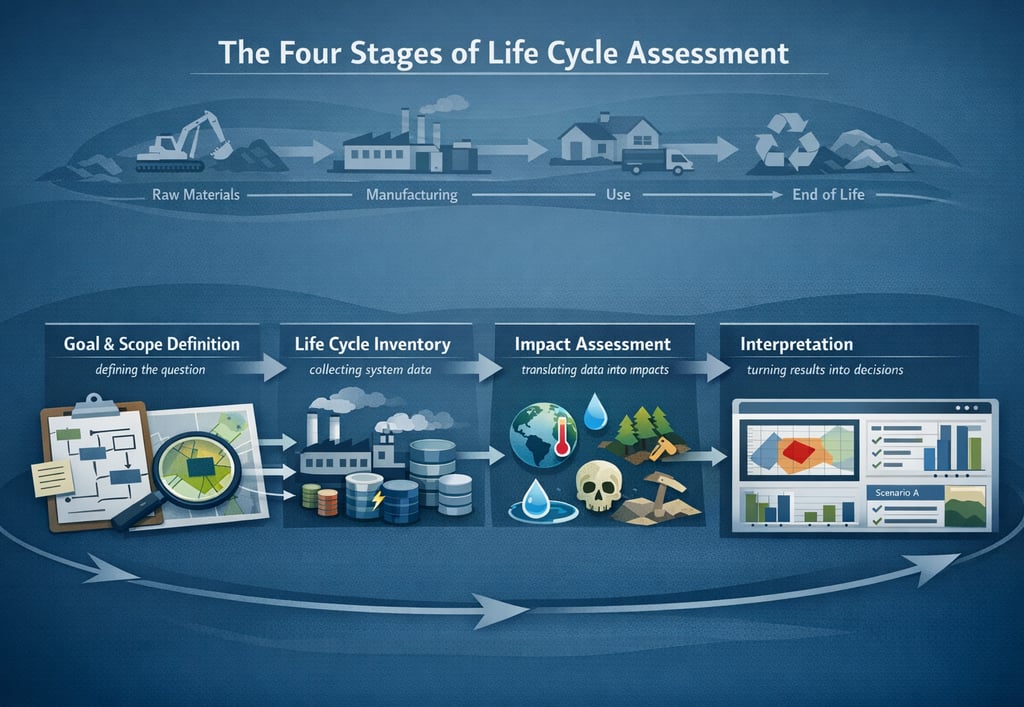
The methodology for environmental Life Cycle Assessment (eLCA) is standardized by the international standards ISO 14040 and ISO 14044, which define four essential stages:
Goal and scope definition
Life cycle inventory (LCI)
Life cycle impact assessment (LCIA)
Interpretation
Each stage plays a distinct role in transforming raw data into meaningful environmental insight.
1. Goal and Scope Definition: Defining the Question
The first stage of an LCA establishes why the study is being conducted and how it will be structured.
This stage defines the purpose of the assessment and ensures that the analysis remains focused and relevant.
Key elements determined during this phase include:
Goal of the study – the reason for conducting the assessment (for example, comparing two technologies or evaluating environmental performance).
Functional unit – the reference unit used to compare systems (such as 1 kg of product or 1 kWh of energy produced).
System boundaries – which processes are included in the analysis (for example, raw material extraction, manufacturing, use, and end-of-life).
Assumptions and limitations – defining methodological choices and constraints.
The goal and scope stage is critical because it determines what the LCA will measure and how results should be interpreted.
If the functional unit or system boundaries are poorly defined, the entire assessment can become misleading.
In other words, a clear goal and scope ensure that the LCA answers the right question.
2. Life Cycle Inventory (LCI): Collecting the Data
Once the scope is defined, the next step is to compile the Life Cycle Inventory (LCI).
The LCI is essentially the data collection phase of the assessment.
During this stage, all relevant inputs and outputs of the system are quantified, including:
raw materials
energy consumption
water use
emissions to air, water, and soil
waste generation
transportation flows
The result is a detailed inventory of all material and energy flows associated with the product or process being analyzed.
For complex systems such as biorefineries or industrial production processes, the LCI often requires large datasets and detailed process modeling.
This stage is typically the most time-consuming part of an LCA because the quality of the final results depends heavily on the accuracy and completeness of the data collected.
Without a robust inventory, the environmental analysis that follows cannot be reliable.
3. Life Cycle Impact Assessment (LCIA): Understanding Environmental Effects
The third stage translates the inventory data into potential environmental impacts.
This step is known as the Life Cycle Impact Assessment (LCIA).
During LCIA, the inputs and emissions identified in the inventory are associated with environmental impact categories such as:
climate change (greenhouse gas emissions)
acidification
eutrophication
human toxicity
resource depletion
land use
Scientific models are used to estimate how each emission or resource use contributes to these environmental effects.
For example:
carbon dioxide emissions contribute to climate change
nitrogen compounds can contribute to eutrophication
sulfur emissions may cause acidification
By converting raw inventory data into impact indicators, LCIA provides a clearer picture of how a system affects the environment.
This stage enables meaningful comparisons between different technologies or scenarios.
For instance, the environmental impacts of different biorefinery configurations can be evaluated and compared with a fossil-based reference system.
4. Interpretation: Turning Results into Insight
The final stage of LCA is interpretation.
This stage evaluates the results from the inventory and impact assessment to draw meaningful conclusions.
Interpretation involves:
identifying the processes that contribute most to environmental impacts
evaluating uncertainties and limitations in the data
checking consistency with the defined goal and scope
comparing different scenarios or technological alternatives
In many studies, interpretation focuses on comparing systems—for example:
different biorefinery configurations
renewable vs fossil-based systems
alternative materials or production processes
The purpose is to identify which option performs better environmentally and why.
Interpretation also highlights hotspots, which are stages in the life cycle where environmental impacts are particularly significant.
These insights can guide decision-making in product design, process optimization, and sustainability strategy.
Why All Four Stages Are Essential
The four stages of LCA form a structured process that transforms complex environmental data into actionable insight.
Each stage contributes a critical element:
Goal and scope definition ensures the study addresses the right problem.
Life cycle inventory provides the data foundation for analysis.
Impact assessment translates data into environmental consequences.
Interpretation turns results into meaningful conclusions and recommendations.
If any stage is poorly executed, the reliability of the entire assessment can be compromised.
For example:
an unclear scope can produce misleading comparisons
incomplete inventory data can distort impact calculations
weak interpretation may overlook important insights
This is why international standards emphasize a systematic approach to LCA.
Life Cycle Thinking Beyond the Assessment
Life Cycle Assessment is not only a research tool.
It also supports practical decision-making in areas such as:
sustainable product design
circular economy strategies
industrial process optimization
environmental policy development
By examining impacts across the entire life cycle, LCA helps organizations avoid shifting environmental burdens from one stage to another.
Instead of focusing only on production or waste management, LCA encourages a system-wide perspective.
A Final Thought
Environmental impacts are rarely created at a single point in a system.
They emerge from a chain of interconnected processes that extend from resource extraction to final disposal.
Life Cycle Assessment provides a structured framework to understand this complexity.
But its strength lies in the integration of all four stages.
Only when goal definition, inventory analysis, impact assessment, and interpretation work together can LCA deliver reliable insights that support better environmental decisions.