
The EU SSbD Framework for Designing Chemicals and Materials
The EU SSbD Framework for Designing Chemicals and Materials: from policy ambition to operational decision-making
1/26/20263 min read
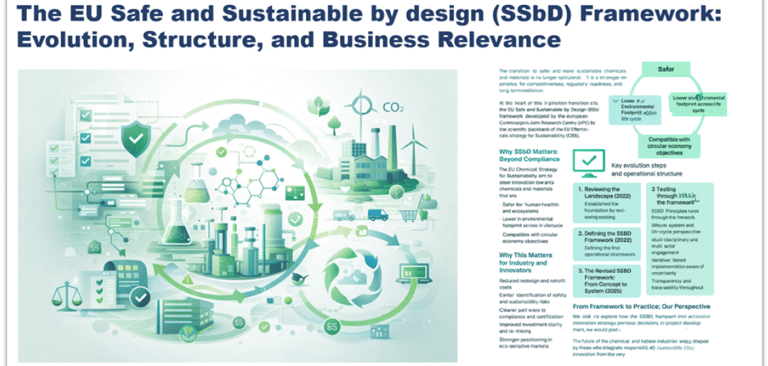
The transition to safer and more sustainable chemicals and materials is no longer optional—it is a strategic imperative for competitiveness, regulatory readiness, and long-term resilience. At the heart of this transition sits the EU Safe and Sustainable by Design (SSbD) framework, developed by the European Commission’s Joint Research Centre (JRC) as the scientific backbone of the EU Chemicals Strategy for Sustainability (CSS).
Since its introduction in 2022, the SSbD framework has evolved through multiple publications, practical testing, and stakeholder feedback. Together, these documents form a coherent and increasingly operational approach to embedding safety, sustainability, and circularity into chemical and material innovation—starting from the earliest design stages.
This article provides an overview of the evolution of the EU SSbD framework, its structure, and why it matters for companies operating in chemicals, materials, and bio-based value chains.
Why SSbD Matters: Beyond Compliance
The EU Chemical Strategy for Sustainability aims to steer innovation towards chemicals and materials that are:
Safer for human health and ecosystems
Lower in environmental footprint across their life cycle
Compatible with circular economy objectives
Competitive and investable in global markets
SSbD responds to a key challenge: how to integrate safety, sustainability, and functionality into one coherent decision framework, rather than treating them as separate or sequential checks.
Crucially, SSbD is not a single assessment. It is a continuous, iterative improvement system that supports innovation under uncertainty—especially at early technology readiness levels.
The Evolution of the EU SSbD Framework
1. Reviewing the Landscape (2022)
The first JRC publication established the foundation by reviewing existing approaches to Safe and Sustainable by Design. It mapped:
Safety and sustainability dimensions
Assessment methods, indicators, and tools
Existing gaps between risk-based safety assessment and life-cycle-based sustainability evaluation
The key conclusion was clear: a new integrated framework was needed—one that combines risk assessment, life cycle thinking, and systems perspectives across entire value chains.
2. Defining the SSbD Framework (2022)
Building on this review, the second publication introduced the first operational SSbD framework for chemicals and materials.
Key characteristics included:
Integration of safety, circularity, functionality, and sustainability
Life-cycle coverage from raw materials to end-of-life
Alignment with industrial innovation processes rather than regulatory-only evaluation
SSbD was positioned as a tool to support design, development, production, and use, helping innovators avoid regrettable substitutions while improving environmental and economic performance.
3. Testing Through Case Studies (2023)
The third publication moved from theory to practice. The framework was applied to illustrative case studies, demonstrating how SSbD can:
Identify safety and sustainability hotspots early
Reveal trade-offs between performance, risk, and environmental impact
Guide redesign decisions before costly lock-ins occur
These applications confirmed that SSbD works even with imperfect or screening-level data, making it especially relevant for early innovation and SMEs.
The Revised SSbD Framework (2025): From Concept to System
After extensive testing by industry, research organisations, and public authorities, the SSbD framework was revised in 2025 to improve clarity, operability, and relevance.
Key Innovations in the Revised Framework
1. SSbD Principles as the Backbone
Four core principles now explicitly guide the framework:
Whole-system and life-cycle perspective
Multidisciplinary and multi-actor engagement
Iterative, tiered, and uncertainty-aware implementation
Transparency and traceability throughout innovation
SSbD is no longer static—it evolves with new data, new risks, and new solutions.
2. Structured Scoping Analysis
The scoping analysis is now a formal starting point, defining:
The intended innovation
Life-cycle boundaries and actors
Data availability and maturity
Decision rules and objectives
This step allows the SSbD application to be tailored—from simplified screening to full life-cycle implementation.
3. A Re-structured Assessment Architecture
The revised framework introduces a clearer separation and integration of assessment domains:
Safety
Intrinsic chemical and material properties
Human health and environmental exposure
Process-related safety across supply chains
Environmental Sustainability
Full life-cycle assessment (LCA)
Screening approaches and benchmarks for low TRLs
Process-level sustainability comparisons
Socio-Economic Sustainability
Supply chain vulnerabilities
Life cycle costs
Critical raw materials dependence
Skills, jobs, and competitiveness
Together, these assessments enable holistic decision-making, not isolated optimisation.
4. Evaluation and Decision Support
Results are synthesised through an evaluation step that:
Identifies trade-offs and uncertainties
Highlights hotspots across the life cycle
Uses dashboards as a “compass” for innovation
This directly supports investment decisions, R&D prioritisation, and risk governance.
5. Documentation and Traceability
A dedicated documentation component ensures that:
Decisions are transparent
Assumptions are explicit
Progress across iterations is traceable
This is essential for regulatory readiness, funding alignment, and internal governance.
Why This Matters for Industry and Innovators
The SSbD framework delivers tangible value:
Reduced redesign and retrofit costs
Earlier identification of safety and sustainability risks
Clearer pathways to compliance and certification
Improved investment clarity and de-risking
Stronger positioning in eco-sensitive markets
It also aligns with global trends, including the Global Framework on Chemicals and international calls for Responsible Research and Innovation.
From Framework to Practice: Our Perspective
At our consultancy, we work with companies to translate the EU SSbD framework into actionable decision-making tools—tailored to real innovation contexts, real data constraints, and real business pressures.
SSbD is not about adding another layer of assessment.
It is about designing safety, sustainability, and circularity into innovation from the very beginning.
The future of the chemical and bio-based industries will be shaped by those who integrate responsibility and performance—systematically, transparently, and early.
If you would like to explore how SSbD can support your innovation strategy, portfolio decisions, or project development, we would be glad to support you.