
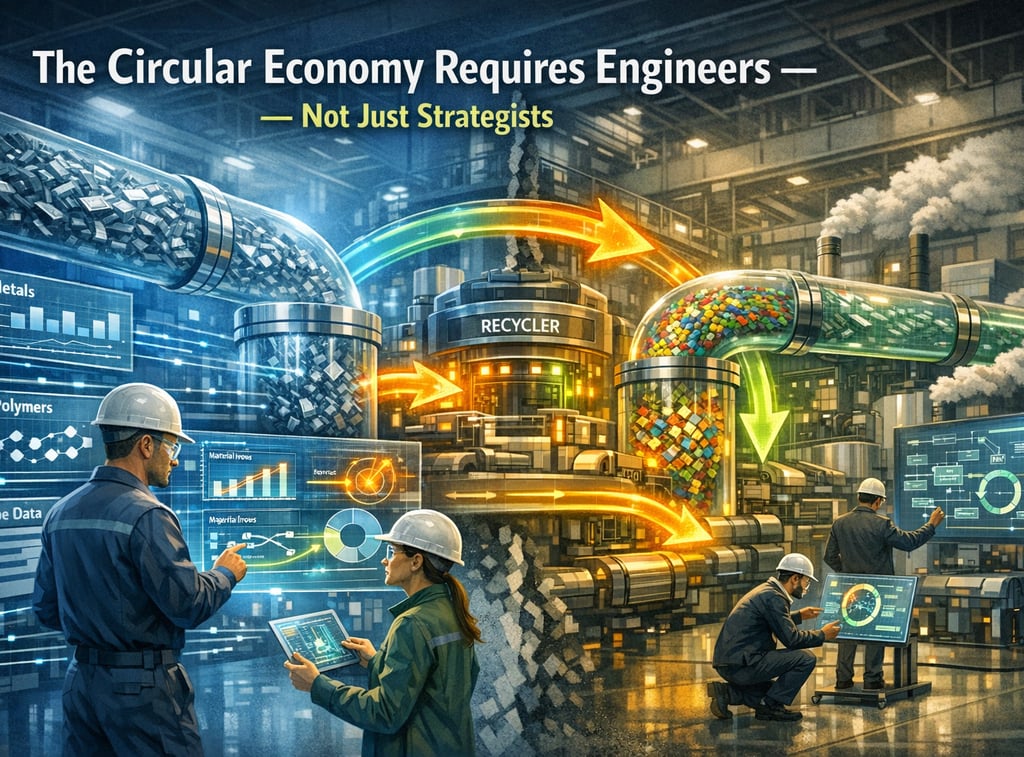
The Circular Economy Requires Engineers — Not Just Strategists
Circular Economy Needs More Than Strategy It needs engineering that actually works.
3/16/20262 min read
The circular economy has become one of the most powerful ideas in sustainability. Governments endorse it. Corporations publish circular roadmaps. Consultants present elegant strategy decks about closing loops and eliminating waste.
But there is a problem hiding beneath the optimism:
Circularity discussions often ignore engineering reality.
Strategies can promise closed loops.
Physics decides whether they actually exist.
Circularity Looks Simple on Slides
Circular economy diagrams are beautifully simple: materials circulate in perfect loops, products are reused indefinitely, and waste disappears.
But anyone who has worked inside manufacturing knows something different.
Every material has limits.
Every process has constraints.
Every recycling step loses energy and quality.
In other words:
Circular systems are governed by engineering, not just intention.
When circular economy strategies ignore this, they fail quietly — until physics finally enters the conversation.
Material Flows Are Not Abstract
Many circular economy discussions treat materials like interchangeable tokens moving through a system.
In reality, materials behave very differently.
Metals can often be recycled repeatedly, but require high energy input.
Polymers degrade with each cycle.
Composite materials are frequently impossible to separate economically.
Additives and coatings contaminate recycling streams.
Engineers deal with these realities every day.
Without understanding material flows at a technical level, circular strategies become theoretical exercises.
Recycling Has Thermodynamic Limits
One of the most overlooked realities of circular economy systems is thermodynamics.
Recycling always requires energy.
Sorting, separation, melting, purification, remanufacturing — every step consumes energy and creates losses.
Even in the best-designed systems:
Materials degrade
Energy is required
Yield is never 100%
This does not mean circularity is impossible. It means circularity must be engineered carefully, not assumed.
Ignoring thermodynamics leads to unrealistic circular claims and fragile business models.
Process Constraints Shape What Is Possible
Circular economy thinking often focuses on design principles.
But the real constraints frequently appear in industrial processes.
For example:
A material may be theoretically recyclable, but not compatible with existing recycling infrastructure.
A product may be designed for disassembly, but require manual labor that makes recovery economically impossible.
A substitute material may be sustainable on paper, but incompatible with current manufacturing equipment.
These are not strategy problems.
They are engineering problems.
Where Circular Strategies Break Down
Many organizations begin their circular journey with ambitious goals:
100% recyclable products
fully closed material loops
zero waste manufacturing
But as implementation begins, engineering challenges emerge:
material degradation
contamination
process incompatibilities
economic constraints
Suddenly, the elegant circular diagram becomes much more complicated.
And that is exactly where engineering expertise becomes essential.
The Next Phase of Circular Economy
The first wave of circular economy thinking was driven by strategy and vision.
That phase was necessary. It helped organizations imagine a different industrial system.
But the next phase will be different.
Circularity will increasingly be shaped by:
materials science
process engineering
industrial systems design
energy efficiency
product architecture
In other words:
The circular economy is moving from concept to engineering.
And that transition will determine which companies succeed.
Circularity Must Be Engineered
If companies want circular systems that actually work, they must integrate engineering early in their sustainability strategies.
That means asking questions like:
Can this material survive multiple recycling cycles?
What energy input is required to recover it?
Are separation technologies available at scale?
Does existing infrastructure support the loop?
These questions may sound technical.
But they are exactly the questions that determine whether circularity is achievable.
The Reality Check
Circular economy strategies often begin with ambition.
But ambition alone cannot close material loops.
Eventually, every circular vision encounters the same reality:
physics.
And when that moment arrives, organizations discover something important:
The circular economy does not just require strategists.
It requires engineers.