
Social and Corporate Strategic Needs: SSbD-Supportive Business Models and Regenerative Leadership
Designing sustainability requires redesigning how we lead and create value. From SSbD to regenerative business models.
2/4/20264 min read
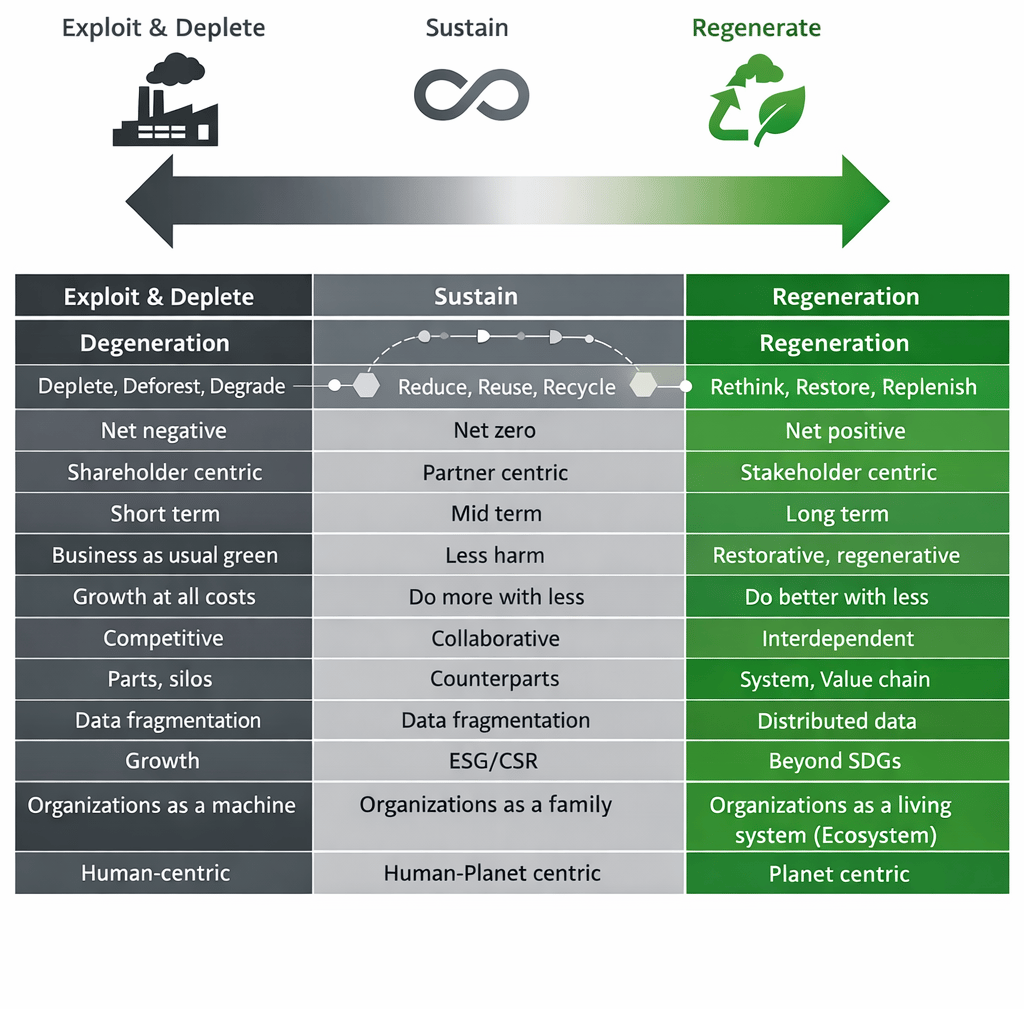
The sustainability challenge facing organizations today is no longer defined by ambition alone. Net-zero targets, ESG commitments, and sustainability strategies have become mainstream. Yet many organizations are beginning to recognize a deeper issue: sustainability, as it is currently practiced, may not be sufficient.
The next strategic frontier is not simply doing less harm, but actively creating positive social and environmental value. This shift requires two fundamental changes: the development of business models that are supportive of Safe and Sustainable by Design (SSbD), and the emergence of a new leadership paradigm—regenerative leadership.
Together, these elements move organizations beyond compliance and risk management toward long-term resilience, value creation, and societal contribution.
From Net Zero to Net Positive Sustainability
Traditional sustainability approaches are often built around reduction logic: reduce emissions, reduce waste, reduce risk. While necessary, this mindset is inherently defensive. It assumes that the best outcome is minimizing negative impact.
SSbD challenges this assumption.
By embedding safety, sustainability, and life-cycle thinking at the design stage, SSbD opens the door to net-positive outcomes—solutions that restore ecosystems, strengthen communities, and enhance long-term business value. However, SSbD cannot succeed if it is layered onto business models that are still optimized for short-term extraction or cost minimization.
SSbD requires business models that are intentionally designed to sustain and regenerate—not just operate more efficiently.
Why Business Models Must Evolve
Many existing business models were developed in a context of abundant resources, linear value chains, and limited environmental accountability. As a result, they tend to externalize social and environmental costs, even when sustainability strategies are in place.
SSbD-supportive business models differ in several important ways:
They integrate sustainability criteria directly into value creation logic, not as a constraint but as a design parameter.
They apply life-cycle thinking to understand impacts across supply chains, product use, and end-of-life.
They align incentives so that environmental and social performance reinforce, rather than compete with, economic performance.
They create value for multiple stakeholders, including employees, communities, ecosystems, and future generations.
In this context, sustainability is no longer a function or department—it becomes part of how the organization creates and captures value.
Regenerative Leadership: A Shift in How Organizations Are Led
Business model transformation cannot happen without a corresponding shift in leadership.
Regenerative leadership represents a move away from control-oriented, short-term decision-making toward a leadership style that is long-term, systems-oriented, and stakeholder-centric. It recognizes organizations as living systems embedded within larger social and ecological systems.
Key characteristics of regenerative leadership include:
Long-term orientation: Decisions are evaluated not only for immediate performance, but for their impact over decades.
Planet-centric thinking: Environmental systems are treated as strategic assets, not external constraints.
Lifecycle awareness: Leaders understand how early design and strategic decisions lock in future impacts and risks.
Purpose and empathy: Leadership is grounded in meaning, responsibility, and care for people and nature.
Value redefinition: Success is measured by the organization’s ability to rethink, restore, and replenish—rather than only reduce, reuse, and recycle.
This leadership approach goes beyond established sustainability frameworks and development goals. It focuses on thriving systems, not just surviving ones.
From Sustainable to Regenerative Organizations
A useful way to understand this transition is to compare three broad business model archetypes:
Extractive models, which exploit resources and deplete social and environmental capital.
Sustaining models, which aim to reduce harm and maintain current systems.
Regenerative models, which actively restore ecosystems, strengthen social systems, and create conditions for long-term resilience.
SSbD clearly aligns with the third category.
A regenerative business enriches all its stakeholders, including society and the environment. This is reflected not only in products and services, but in culture, governance, operations, strategy, and relationships across the value chain.
Regenerative leadership, in turn, is about cultivating life-affirming conditions—inside the organization and beyond it. It enables teams to integrate social sustainability principles into everyday work, decision-making, and collaboration.
Collaboration as a Core Capability
Regenerative approaches also demand new ways of working together.
No organization can deliver net-positive outcomes in isolation. SSbD-supportive business models rely on collaboration across value chains, sectors, and disciplines. Leaders must be capable of fostering partnerships between business, science, communities, and nature.
This requires:
Openness to shared value creation rather than zero-sum competition
Governance structures that support learning and adaptation
Decision frameworks that balance uncertainty, risk, and opportunity
In this sense, regenerative leadership is as much about enabling collaboration as it is about setting direction.
Implications for Strategy and Practice
For organizations operating in Europe and Latin America—regions facing both regulatory pressure and profound social-environmental challenges—the implications are clear.
The transition to SSbD-supportive business models and regenerative leadership is not a branding exercise. It is a strategic transformation that affects:
How products and services are designed
How investments are prioritized
How performance is measured
How leaders make decisions under uncertainty
How organizations relate to society and the environment
Those that embrace this shift early will be better positioned to manage risk, attract talent, build trust, and create durable value in an increasingly constrained world.
Closing Thought
The future of sustainability leadership will not be defined by who publishes the most ambitious commitments, but by who redesigns their business and leadership models to support life—human and natural—over the long term.
SSbD provides the technical and scientific foundation.
Regenerative leadership provides the mindset and direction.
Together, they offer a credible path from sustainability as obligation to sustainability as opportunity.