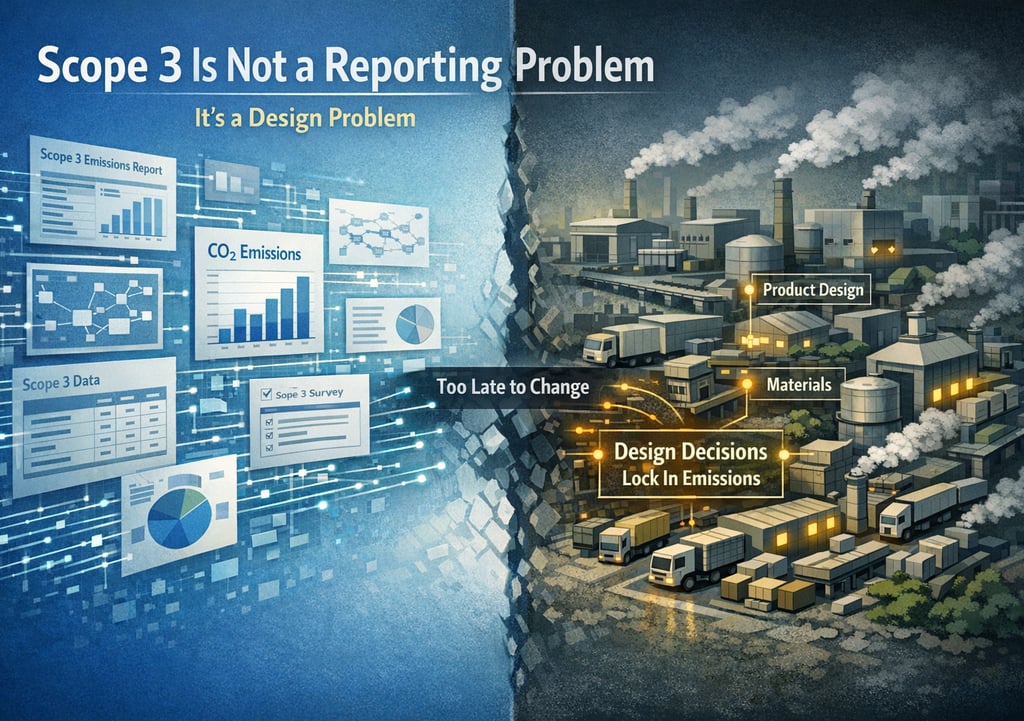
Scope 3 Is Not a Reporting Problem — It’s a Design Problem
Scope 3 emissions are treated as a measurement challenge. In reality, they are a consequence of design decisions made long before reporting begins.
3/13/20264 min read
The Scope 3 Obsession
Across industries, Scope 3 emissions have become the dominant challenge in corporate climate strategies.
Organizations invest heavily in:
• supplier questionnaires
• emissions databases
• lifecycle models
• reporting platforms
• carbon accounting tools
The goal is simple: measure emissions across the value chain.
But measurement alone rarely changes the outcome.
Companies often discover the same uncomfortable reality:
the majority of their emissions occur outside their direct control.
This leads to frustration, complexity, and endless data collection.
Yet the core issue is not the difficulty of measurement.
It is the structure of the system being measured.
Scope 3 emissions are not primarily a reporting problem.
They are the result of design choices.
Where Scope 3 Actually Comes From
Scope 3 emissions emerge from decisions made long before a product reaches the market.
They originate in:
• product architecture
• material selection
• supplier choices
• manufacturing pathways
• logistics structures
• product lifetime assumptions
These decisions determine:
• how much energy is embedded in materials
• how complex supply chains become
• how far components travel
• how products are used and disposed of
By the time organizations begin calculating Scope 3 emissions, the system that created them is already in place.
Reporting reveals the footprint.
It does not change it.
The Measurement Trap
Many companies fall into a predictable cycle.
First, they invest in better data:
• more supplier engagement
• more detailed carbon accounting
• more sophisticated reporting systems
Second, they produce increasingly precise estimates of value-chain emissions.
Third, they realize the numbers are extremely large — and extremely difficult to influence.
The organization concludes that Scope 3 is simply hard.
But what is really happening is structural.
Companies are trying to measure their way out of a design problem.
Product Architecture Defines Emissions
One of the most powerful determinants of Scope 3 emissions is product design.
Design choices shape emissions in ways that reporting cannot correct.
Consider a few examples:
Material selection
A design that relies heavily on carbon-intensive materials will lock in emissions regardless of supplier efficiency.
Component complexity
Highly fragmented product architectures increase supply chain layers, transportation, and energy use.
Assembly choices
Certain manufacturing processes demand energy-intensive steps that cannot easily be optimized later.
Product lifespan
Short product lifecycles multiply manufacturing emissions across the system.
These decisions happen early in the innovation process.
Once the product architecture is finalized, emissions become structurally embedded.
Procurement Has Hidden Leverage
Scope 3 emissions also reflect procurement decisions.
Suppliers determine:
• production technologies
• energy sources
• material processing methods
• transportation distances
Procurement teams often optimize for:
• cost
• reliability
• delivery speed
Sustainability considerations may exist, but they rarely dominate decision-making.
Without integrating emissions criteria into procurement frameworks, organizations limit their ability to influence Scope 3.
Supplier engagement cannot compensate for structural purchasing decisions.
Why Reporting Alone Cannot Solve Scope 3
Reporting frameworks have improved dramatically.
Standards are clearer.
Tools are more sophisticated.
Disclosure expectations are rising.
Yet reporting systems have one fundamental limitation:
They describe the system as it exists.
They do not redesign it.
When organizations focus exclusively on accounting, they risk turning Scope 3 into an exercise in documentation rather than transformation.
The result is often:
• more data
• more uncertainty
• limited operational change
This is why some companies feel overwhelmed by Scope 3 requirements.
The reporting effort grows, while the ability to reduce emissions remains constrained.
Designing Scope 3 Out of the System
The organizations that make real progress on Scope 3 approach the challenge differently.
They treat emissions as a design variable, not just a reporting output.
This means integrating carbon considerations into decisions about:
Product design
Engineers evaluate materials, architectures, and manufacturing pathways through a life-cycle perspective.
Supplier strategy
Procurement incorporates emissions performance alongside cost and reliability.
Innovation pipelines
Research and development teams explore lower-impact technologies early in product development.
Business models
Companies rethink product lifecycles, maintenance structures, and circular pathways.
When these decisions shift, Scope 3 emissions change with them.
The Role of Life Cycle Thinking
Life cycle thinking provides a framework for identifying where emissions originate.
But its value depends on timing.
Applied late in the process, life cycle assessments often confirm what cannot easily be changed.
Applied early, they become powerful design tools.
This is where approaches such as Safe and Sustainable by Design (SSbD) become critical.
SSbD pushes sustainability considerations upstream into:
• material selection
• process design
• system architecture
Instead of measuring impacts after the fact, organizations design systems where impacts are lower from the start.
Europe and the Growing Scope 3 Pressure
In Europe, regulatory pressure is accelerating the importance of Scope 3.
Frameworks such as:
• the Corporate Sustainability Reporting Directive (CSRD)
• emerging product sustainability regulations
• supply chain due diligence requirements
are forcing companies to look beyond their operational emissions.
For many organizations, this reveals the scale of value-chain impacts for the first time.
The risk is that companies respond by expanding reporting infrastructure without addressing structural drivers.
The opportunity is to embed emissions considerations into design and procurement decisions.
From Accounting to Architecture
Scope 3 emissions are ultimately a reflection of how systems are built.
When product architecture, supplier networks, and material flows are designed without considering carbon impacts, emissions become unavoidable.
Reporting can expose the problem.
But only design decisions can solve it.
Organizations that recognize this shift their focus from accounting to architecture.
They redesign systems so that emissions fall naturally as part of operational logic.
A Final Thought
Scope 3 is often described as the hardest part of corporate decarbonization.
Not because it is difficult to measure — but because it requires organizations to rethink how products and supply chains are designed.
You cannot report your way out of Scope 3.
You must design your way out.
At Abaeco Consultants, we help organizations integrate life-cycle thinking, circularity, and Safe and Sustainable by Design into innovation and procurement decisions — addressing Scope 3 where it actually originates.
Because the most effective emissions reductions happen before the numbers are ever reported.