
Safe and Sustainable by Design Is Not a Checklist — It’s a Design Discipline
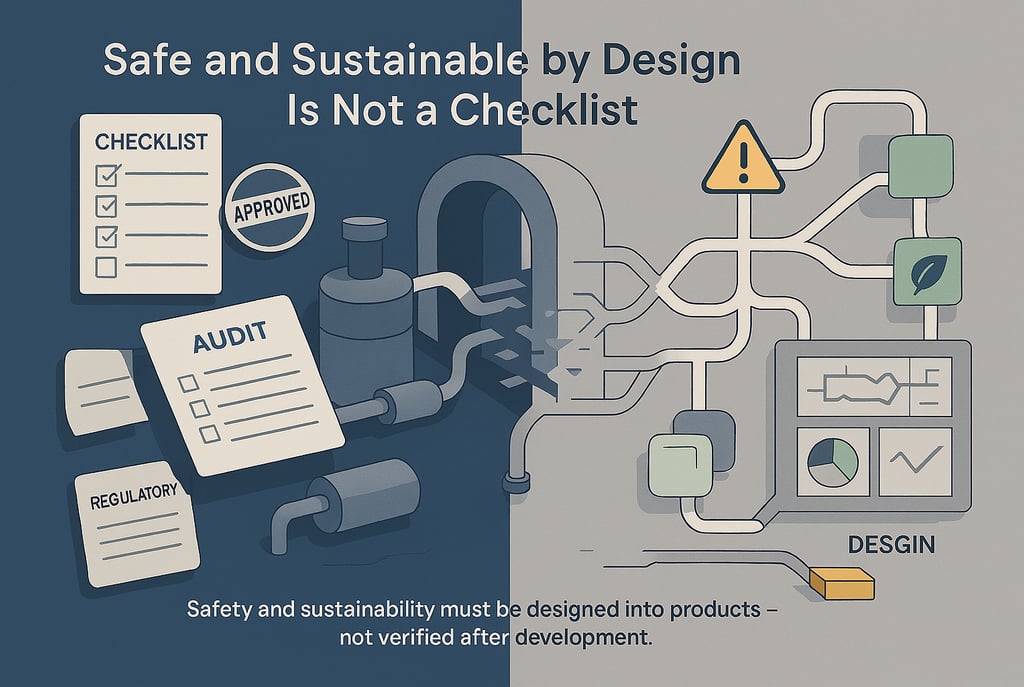
Safe and Sustainable by Design is often treated as a regulatory requirement. In reality, it is a design discipline that determines whether sustainability succeeds or fails.
3/9/20264 min read
Safety and Sustainability Cannot Be Added Later
Across industries, organizations increasingly acknowledge the importance of Safe and Sustainable by Design (SSbD). Regulatory frameworks, innovation programs, and sustainability strategies frequently reference it as a guiding principle.
Yet in practice, many companies treat SSbD as a compliance exercise rather than a design methodology.
The pattern is familiar:
• design decisions are made
• materials and processes are selected
• performance targets are fixed
• development progresses toward commercialization
Only later does the question arise:
Is this solution safe and sustainable?
At that stage, the design is largely locked in.
When safety or sustainability concerns appear, the available options are limited to mitigation, documentation, or compensation.
But the most powerful sustainability decisions were already made earlier — often without being recognized as such.
This is why SSbD cannot function as a checklist.
It must function as a design discipline embedded into engineering and innovation processes.
The Moment Where Sustainability Is Determined
In product development and process engineering, the majority of environmental and safety impacts are determined during early design stages.
Choices made during conceptual design shape:
• material composition
• chemical pathways
• energy requirements
• process conditions
• product architecture
• recoverability and circular potential
Once these parameters are fixed, the system becomes progressively harder to change.
Later improvements typically focus on:
• emissions control
• waste management
• monitoring systems
• operational optimization
These measures are valuable — but they address consequences rather than causes.
SSbD shifts attention upstream.
Instead of asking how to mitigate impacts, it asks:
How can we design systems where these impacts never arise in the first place?
Hazard Reduction vs. End-of-Pipe Mitigation
Traditional environmental management often relies on end-of-pipe solutions.
Filters remove pollutants.
Treatment systems clean wastewater.
Safety protocols manage hazardous substances.
These tools are essential — but they operate after risks have already been introduced into the system.
SSbD follows a different hierarchy.
The first question is not how to control hazards, but how to eliminate or reduce them through design.
For example:
• replacing hazardous substances with safer alternatives
• designing processes that operate under milder conditions
• selecting materials that enable recovery and reuse
• simplifying product architectures to avoid contamination or separation barriers
When risks are addressed at the design stage, the entire system becomes simpler, safer, and more resilient.
The cost of mitigation decreases dramatically because the hazard itself has been reduced.
Why SSbD Often Becomes a Checklist
Despite its potential, SSbD frequently becomes reduced to a procedural step.
Organizations develop:
• compliance forms
• screening questionnaires
• documentation requirements
• late-stage review processes
These mechanisms provide structure and traceability.
But they rarely influence the most important decisions.
Why?
Because by the time the checklist appears, the design is already defined.
Engineers and project managers face strong pressure to maintain:
• schedules
• budgets
• performance specifications
At that stage, revisiting foundational design choices is extremely difficult.
The result is predictable.
SSbD becomes something teams demonstrate, rather than something they practice.
Integrating SSbD Into Innovation Pipelines
For SSbD to work, it must be integrated into R&D decision processes, not attached to them.
Organizations that succeed with SSbD do several things differently.
First, they bring sustainability and safety considerations into early design conversations.
Instead of reviewing finished concepts, interdisciplinary teams evaluate alternatives while the system is still flexible.
Second, they connect SSbD to stage-gate decisions in the innovation pipeline.
Key questions are addressed at specific points:
• Are hazardous substances avoidable?
• Does the product architecture enable circular recovery?
• Are safety risks minimized at the process level?
• Are downstream impacts acceptable across the life cycle?
These questions guide design choices rather than audit them afterward.
Third, organizations ensure that design teams retain authority to modify concepts based on SSbD insights.
Without that authority, the framework remains symbolic.
The Role of Life Cycle Thinking
SSbD becomes particularly powerful when combined with life cycle thinking.
Engineering decisions often optimize performance within a narrow system boundary.
However, sustainability impacts frequently emerge outside that boundary, across supply chains and product life cycles.
Life cycle perspectives help reveal:
• upstream resource intensity
• downstream recovery limitations
• unintended environmental trade-offs
• hidden safety risks across value chains
When these insights inform early design decisions, organizations avoid creating systems that are efficient locally but problematic globally.
Europe and Latin America: Different Contexts, Same Challenge
Across Europe, SSbD is gaining prominence through emerging regulatory frameworks and innovation initiatives.
Companies increasingly recognize that future regulation will reward products designed with safety and sustainability in mind.
In Latin America, the drivers are often different.
Organizations face constraints related to infrastructure, supply chains, and investment capacity.
However, the same principle applies:
design decisions determine long-term environmental and operational performance.
Whether the goal is regulatory compliance, resource efficiency, or technological competitiveness, the leverage point remains the same — the design stage.
SSbD as an Engineering Capability
Ultimately, Safe and Sustainable by Design is not a regulatory trend.
It is an engineering capability.
It requires:
• interdisciplinary collaboration
• systems thinking
• early-stage risk evaluation
• the ability to navigate uncertainty during innovation
Organizations that treat SSbD as a design discipline gain a structural advantage.
They develop products and processes that are inherently safer, more resilient, and easier to align with evolving sustainability expectations.
Those that treat it as a checklist often discover its limits too late.
A Final Thought
Safety and sustainability cannot be inspected into a product.
They cannot be documented into existence.
They must be designed.
At Abaeco Consultants, we work with organizations to integrate Safe and Sustainable by Design into engineering and innovation processes — helping teams translate sustainability principles into practical design decisions from the earliest stages of development.
Because the most powerful sustainability intervention is not the one applied at the end of a project.
It is the one made at the beginning.