
Life Cycle Thinking Is Not About Accuracy — It’s About Timing
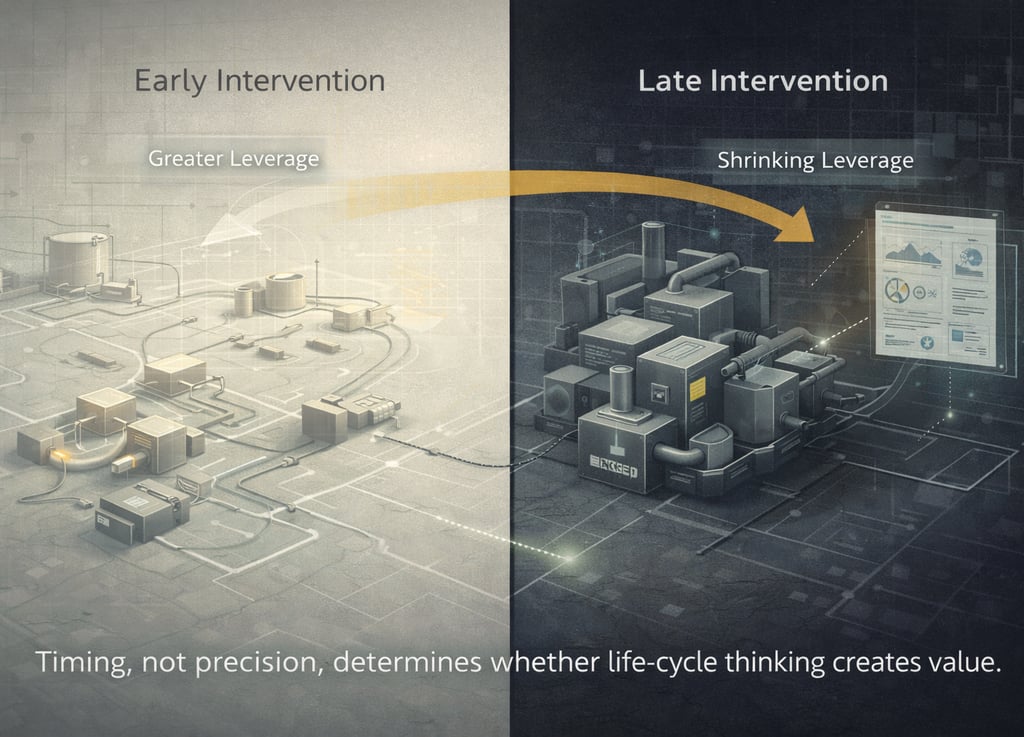
Perfect data arrives too late to matter. Life cycle thinking only creates value when it enters decisions early enough to shape them.
2/25/20261 min read
Precision too late is still failure
Life cycle thinking is often criticized for being imprecise, uncertain, or assumption-heavy.
That criticism misses the point.
Life cycle thinking is not meant to be perfect.
It is meant to be early.
Where Sustainability Outcomes Are Locked In
Most environmental and social impacts are determined:
· before products exist
· before suppliers are selected
· before contracts are signed
· before investments are committed
Waiting for perfect data at this stage is impossible — and unnecessary.
The Cost of Late Precision
Organizations often commission detailed LCAs:
· after designs are frozen
· after suppliers are chosen
· after investments are approved
At that point, accuracy increases — but influence disappears.
The result:
beautiful reports that justify decisions already made.
Life Cycle Thinking as a Design Tool
Used properly, life cycle thinking:
· highlights directional risks
· compares options under uncertainty
· reveals leverage points
· frames trade-offs early
Its value is not numerical certainty — but decision relevance.
SSbD Depends on Timing
Safe and Sustainable by Design only works when life cycle insights enter decisions early enough to matter.
Late-stage precision cannot compensate for early-stage silence.
A Final Thought
A rough life-cycle insight today beats a perfect assessment tomorrow.
Sustainability is shaped by timing — not decimals.