
The Hidden Design Decisions That Determine 80% of Sustainability Outcomes
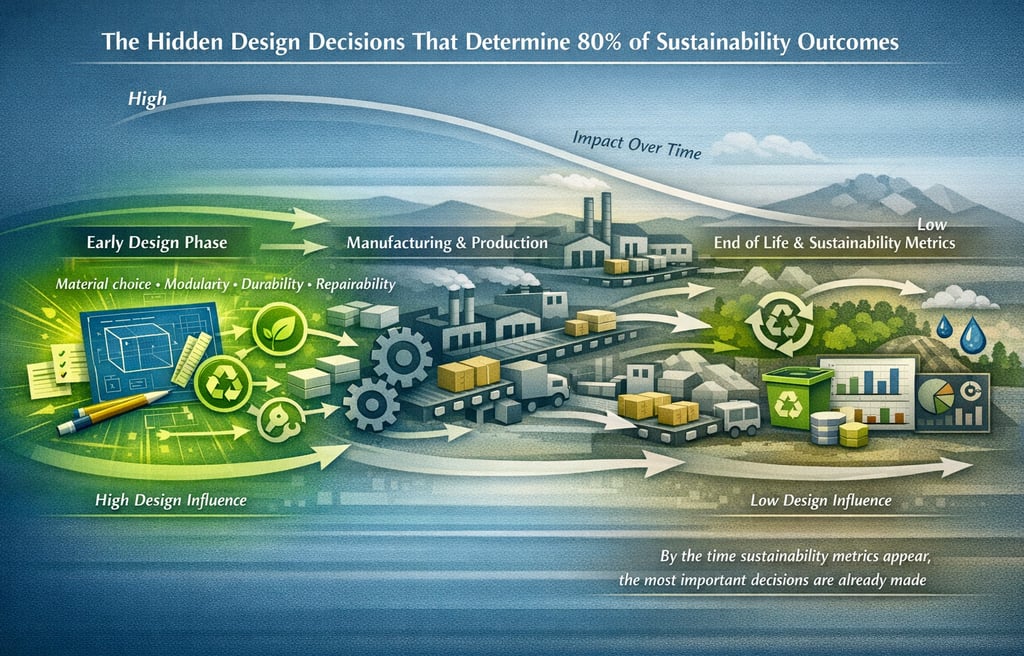
Most environmental impacts are not determined in factories or supply chains — they are determined during the earliest design decisions. Material selection, product architecture, durability, and repairability quietly shape the majority of a product’s sustainability outcomes.
3/25/20264 min read
Most sustainability discussions focus on metrics, targets, and reporting.
But by the time those metrics appear on dashboards, the most important decisions have already been made.
The environmental footprint of a product is largely determined long before manufacturing begins, often during the earliest stages of design. Material selection, product architecture, durability, and repairability quietly shape the majority of a product’s environmental impact across its entire life cycle.
In other words, sustainability outcomes are not primarily decided in sustainability reports or corporate strategies.
They are decided in design meetings.
This is why approaches such as Safe and Sustainable by Design (SSbD) and life-cycle thinking are becoming central to modern sustainability practice.
Why Design Determines Sustainability Outcomes
Every product passes through a life cycle:
raw material extraction
material processing
manufacturing
distribution
use
repair or maintenance
recycling or disposal
Each stage generates environmental impacts.
However, many of these impacts are not determined during production. They are determined earlier, when engineers and designers make choices about how a product will function and how it will be built.
Research and industrial experience consistently show that a large proportion of environmental impacts are locked in during early design phases.
Once manufacturing systems, materials, and supply chains are established, changing them becomes expensive and difficult.
This is why the most influential sustainability decisions are often the least visible ones.
Material Choice: The First Sustainability Decision
Material selection is one of the most powerful drivers of environmental performance.
Different materials carry very different environmental footprints depending on:
resource extraction
energy intensity of production
toxicity and safety considerations
recyclability and recovery potential
For example, choosing between different metals, polymers, or bio-based materials can dramatically influence:
greenhouse gas emissions
resource depletion
product recyclability
environmental risks
Material decisions also influence supply chain complexity and regulatory compliance, particularly in industries dealing with chemicals, advanced materials, or high-performance products.
Once materials are selected and integrated into manufacturing systems, replacing them later becomes significantly more difficult.
This makes early material decisions one of the most critical sustainability leverage points.
Modularity: Designing for Circular Systems
Product architecture also plays a crucial role in sustainability outcomes.
One of the most important design strategies is modularity.
Modular products are composed of components that can be replaced, upgraded, or repaired independently. This design approach supports:
product longevity
easier maintenance
remanufacturing
component reuse
Without modular design, products often become difficult to repair or upgrade. Entire devices may need to be replaced even when only a single component fails.
In contrast, modular design can dramatically extend product lifetimes and reduce resource consumption.
For organizations pursuing circular economy strategies, modularity often becomes a precondition for circularity.
Durability: Extending Product Lifetimes
Another often overlooked sustainability decision is durability.
Designing products to last longer can significantly reduce environmental impacts by spreading resource use over a longer period.
Durability influences several aspects of sustainability:
reduced material consumption
fewer replacements
lower waste generation
reduced manufacturing demand
However, durability must be balanced with other considerations such as technological obsolescence and evolving user needs.
Products designed with both durability and adaptability in mind are better positioned to remain useful over time while minimizing environmental burdens.
Repairability: Unlocking Product Longevity
Repairability is increasingly recognized as a key factor in sustainable product design.
Products that can be easily repaired avoid premature disposal and extend the useful life of materials and components.
Design features that support repairability include:
accessible components
standardized fasteners
availability of spare parts
clear maintenance documentation
Regulatory initiatives in several regions are now encouraging or mandating right-to-repair principles, particularly in electronics and consumer goods.
For companies, improving repairability can enhance both environmental performance and customer satisfaction.
But again, repairability must be considered during the design phase. Once products reach the market, redesigning them for repair becomes far more challenging.
The Timing Problem in Sustainability
One of the most common challenges in sustainability management is timing.
Environmental metrics often appear after design decisions have already been made.
Life Cycle Assessment (LCA), carbon footprint calculations, and sustainability reporting are frequently conducted after products are already developed or even launched.
At that point, sustainability teams can measure impacts — but they have limited ability to influence them.
This creates a structural problem in many organizations:
Sustainability is measured after decisions are locked in.
To truly influence environmental outcomes, sustainability insights must enter the decision-making process earlier, during product design and innovation.
Safe and Sustainable by Design: Moving Upstream
The concept of Safe and Sustainable by Design (SSbD) addresses precisely this challenge.
SSbD encourages organizations to integrate safety, environmental performance, and sustainability considerations directly into the design phase of innovation.
Instead of asking:
“How sustainable is this product after it is developed?”
SSbD asks:
“How can we design this product to minimize environmental and safety impacts from the beginning?”
This shift moves sustainability from a reporting function to a design discipline.
Engineers, designers, and innovation teams become central actors in achieving sustainability goals.
Turning Design Decisions into Sustainability Strategy
For many organizations, adopting this design-focused approach requires structural changes.
Sustainability considerations must be integrated into:
research and development processes
product development pipelines
material selection frameworks
supplier collaboration
engineering decision-making
Tools such as life cycle assessment, material screening methods, and circular design principles can help guide these decisions.
But the most important change is cultural.
Sustainability must be understood not as an external constraint but as a design objective.
A Final Thought
Sustainability outcomes rarely emerge from a single initiative or report.
They emerge from thousands of small decisions made during product development.
Material selection. Product architecture. Durability. Repairability.
Each of these decisions quietly shapes environmental performance across the entire life cycle.
By the time sustainability metrics appear on dashboards, most of those decisions are already fixed.
The lesson is simple:
If organizations want better sustainability outcomes, they must influence the moment when design decisions are made.
Because by the time sustainability metrics appear, the most important decisions have already been made.