
From Total Quality Management to Safe and Sustainable by Design
Why the next evolution of quality is sustainability built into products and systems
3/23/20264 min read
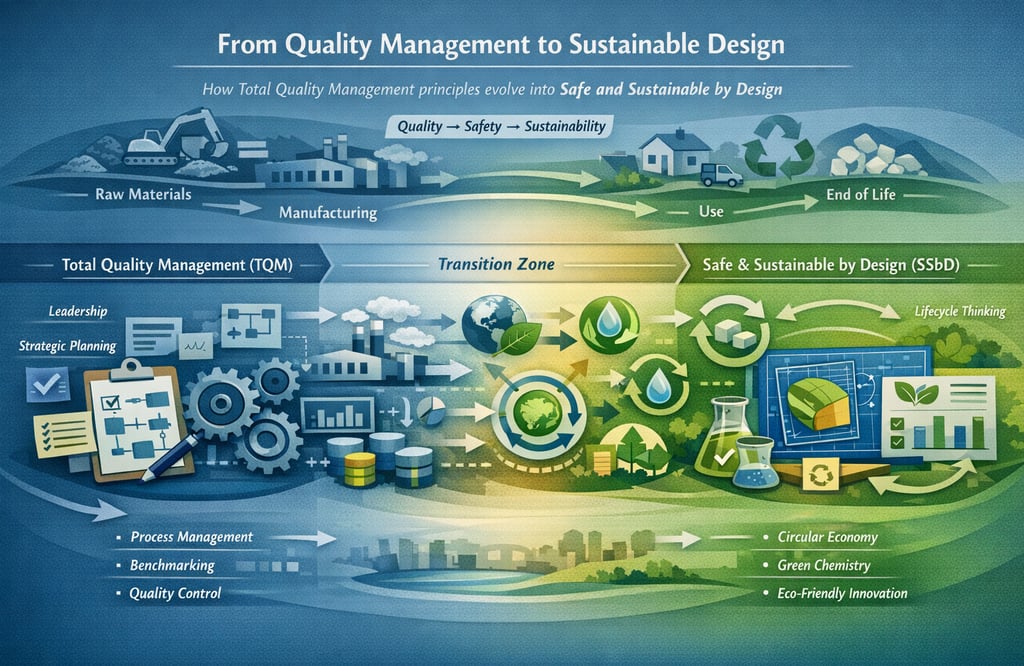
When Quality Meets Sustainability
For decades, Total Quality Management (TQM) transformed how organizations think about performance. It shifted companies from reactive problem-solving to systematic quality built into processes, culture, and leadership.
Today, organizations face a similar transformation with sustainability.
Regulatory pressure, resource constraints, and climate commitments are forcing companies to rethink how products and systems are designed. Frameworks such as Safe and Sustainable by Design (SSbD) push sustainability considerations upstream — into materials, product architecture, and innovation decisions.
Yet many organizations treat SSbD as a new compliance requirement or technical checklist.
In reality, SSbD resembles something much more familiar.
It is essentially quality management for sustainability.
Just as TQM embedded quality into organizational systems, SSbD requires sustainability to be embedded into design, decision-making, and culture.
Leadership: Setting Sustainability as a Design Objective
In TQM, leadership defines the quality vision and objectives that guide the organization.
Without leadership commitment, quality initiatives become fragmented.
The same applies to SSbD.
Top management must establish sustainability as a strategic design objective, not merely a reporting obligation. This includes setting clear goals related to material safety, environmental performance, and lifecycle impacts.
Leadership also determines the resources, timelines, and cost priorities necessary to integrate sustainability into product development.
Without this commitment, SSbD remains aspirational rather than operational.
Strategic Planning: Aligning Sustainability with Business Goals
TQM emphasizes strategic planning to align quality initiatives with organizational objectives.
SSbD requires the same level of alignment.
Sustainability cannot be an isolated function within environmental departments. It must be integrated into innovation strategies, product portfolios, and long-term business planning.
Strategic planning ensures that sustainability considerations influence decisions about:
research and development
product design priorities
investment in new materials and technologies
When sustainability becomes part of strategic planning, it moves from compliance to competitive advantage.
Customer Focus: Understanding Sustainable Demand
A core principle of TQM is customer focus.
Organizations must understand customer expectations and market trends to deliver quality products.
Today, customer expectations increasingly include sustainability dimensions such as:
product safety
environmental performance
circularity
transparency in supply chains
SSbD requires organizations to translate these expectations into design criteria.
Products that anticipate sustainability expectations are more likely to succeed in markets where environmental performance is becoming a purchasing factor.
Process Management: Designing Sustainable Systems
Process management in TQM focuses on organizing workflows, assigning responsibilities, and ensuring continuous improvement.
SSbD extends this logic into product and system design.
Processes must be structured to ensure sustainability considerations are evaluated during critical stages such as:
material selection
product architecture
manufacturing process development
lifecycle assessments
Automation, digital tools, and data systems can support these processes by providing real-time insights into environmental impacts.
By embedding sustainability checkpoints into development workflows, organizations ensure that environmental considerations are addressed before products reach the market.
Human Resource Management: Empowering Sustainable Decision-Making
TQM highlights the importance of employee participation and empowerment.
Quality improvements rarely emerge solely from management directives; they arise from engaged employees who understand the system and contribute to improvements.
SSbD requires a similar level of engagement.
Engineers, designers, procurement specialists, and operations teams must understand how their decisions influence environmental and safety outcomes.
Empowering employees to take responsibility for sustainability encourages innovation and accelerates problem-solving across the organization.
Information and Analysis: Data for Better Decisions
Quality management relies heavily on measurement, analysis, and performance evaluation.
SSbD also requires robust information systems to evaluate environmental and safety impacts.
Tools such as lifecycle assessment, material flow analysis, and environmental performance indicators enable organizations to assess design options objectively.
Data-driven decision-making ensures that sustainability considerations are integrated into operational and strategic choices.
Supplier Partnerships: Extending Sustainability Across the Value Chain
In TQM, supplier partnerships are essential for maintaining quality across the production system.
Similarly, SSbD requires strong collaboration with suppliers.
Many sustainability impacts originate upstream in material production and component manufacturing.
Building partnerships with suppliers enables companies to:
improve material transparency
identify safer alternatives
reduce environmental impacts across the value chain
Effective supplier engagement transforms sustainability from an internal initiative into a system-wide improvement effort.
Training and Learning: Building Sustainability Competence
Continuous learning is a cornerstone of TQM.
Organizations invest in training programs to ensure employees understand quality standards and improvement methodologies.
SSbD requires similar investment in sustainability knowledge and technical competence.
Employees must develop capabilities in areas such as:
sustainable materials
circular design principles
environmental assessment methods
Training ensures that sustainability becomes an integral part of professional practice rather than an external requirement.
Culture and Communication: Enabling Organizational Change
Quality management initiatives succeed when organizations develop a culture that values continuous improvement.
SSbD also requires cultural transformation.
Sustainability must be understood not as an obstacle to innovation but as an opportunity to improve products and systems.
Clear communication between leadership, managers, and employees helps organizations align around sustainability goals and adapt to new regulatory and market expectations.
Benchmarking: Learning from Best Practices
Benchmarking allows organizations to compare their performance with industry leaders and identify opportunities for improvement.
In sustainability, benchmarking helps organizations understand emerging best practices in areas such as:
circular product design
material substitution
energy-efficient manufacturing
By learning from industry leaders, companies accelerate the integration of SSbD principles into their operations.
Social and Environmental Responsibility: Expanding the Definition of Quality
Traditional quality management focused primarily on product performance and reliability.
Today, organizations must broaden the definition of quality to include environmental and social responsibility.
SSbD embodies this expanded perspective.
Products must not only meet functional requirements but also minimize environmental impacts and protect human health throughout their lifecycle.
Companies that adopt this broader definition of quality often benefit from stronger brand reputation, regulatory readiness, and long-term competitiveness.
From Quality Management to Sustainable Design
The transition from TQM to SSbD reflects a broader shift in how organizations define excellence.
Quality once meant delivering reliable products and efficient processes.
Today, quality must also encompass safety, sustainability, and responsible resource use.
Organizations that apply the principles of TQM to sustainability can integrate SSbD into their innovation systems more effectively.
The lesson from decades of quality management is clear:
Sustainable products do not emerge from isolated initiatives.
They emerge from systems designed to deliver them consistently.
SSbD is not simply another sustainability framework.
It is the next evolution of quality management — where environmental and social performance become integral dimensions of product excellence.