
From Ozone Discovery to Net-Zero: How Global Sustainability Has Transformed Since Mario Molina’s Breakthrough
A clear look at how scientific breakthroughs and international climate agreements paved the way for modern sustainability, circularity, and safe & sustainable by design.
12/12/20253 min read
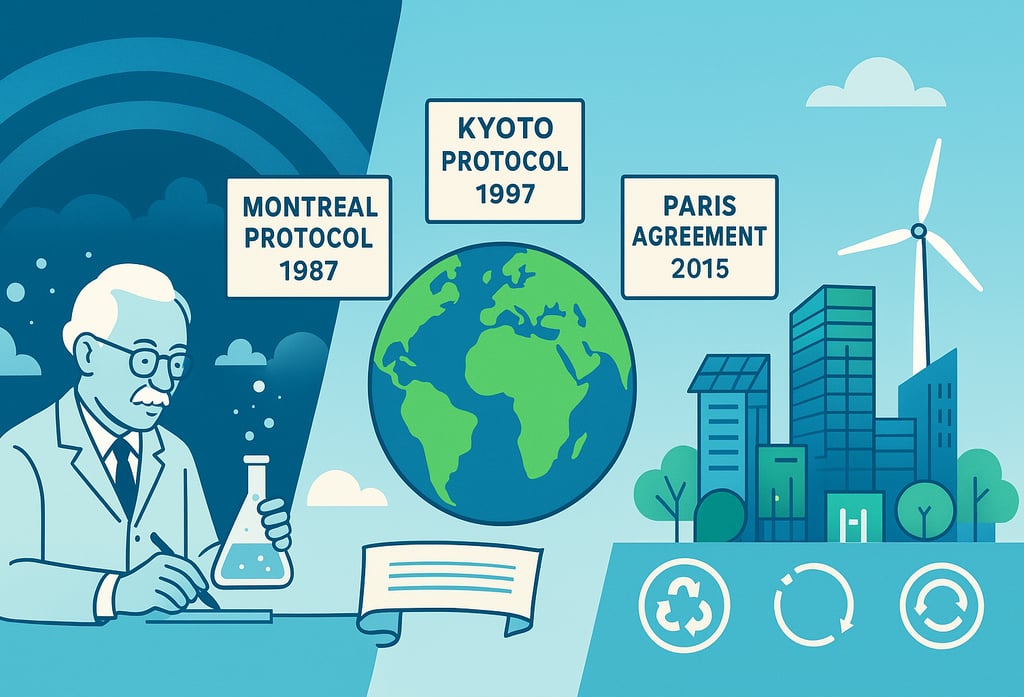
Sustainability as we know it today did not emerge overnight. It is the product of decades of scientific discovery, political negotiation, and corporate innovation. At the heart of this story is the work of Dr. Mario Molina, whose groundbreaking research fundamentally changed the world’s understanding of human-made greenhouse gas (GHG) emissions—and ignited global action that continues to evolve.
Today, the sustainability landscape spans international climate agreements, national decarbonization strategies, corporate ESG commitments, and technological breakthroughs. Below is a clear, business-oriented perspective on how we got here—and what this evolution means for organizations shaping their sustainability strategies today.
1. The Pivotal Discovery: Mario Molina and the Ozone Crisis
In the 1970s, Dr. Mario Molina and Dr. F. Sherwood Rowland uncovered a startling truth: chlorofluorocarbons (CFCs), widely used in aerosols and refrigerants, were destroying the Earth’s ozone layer. Their research identified a direct link between industrial chemicals and atmospheric harm—marking one of the first times human activity was proven to cause global-scale environmental damage.
This discovery sparked:
Global scientific consensus
Public pressure on policymakers
The precedent for coordinated international environmental action
Their work earned the Nobel Prize in Chemistry in 1995 and became the foundation for modern climate governance.
2. The Montreal Protocol: A Template for Global Environmental Success
Adopted in 1987, the Montreal Protocol remains one of the most successful international environmental agreements in history. It mandated the phase-out of CFCs and other ozone-depleting substances, proving that:
International cooperation is possible
Regulations can drive innovation
Industry can adapt quickly when incentives and clarity are provided
Importantly, the Protocol revealed a powerful principle: policy paired with technology creates real environmental change—a lesson that continues to shape climate agreements today.
3. The Kyoto Protocol: The First Global Carbon Agreement
In 1997, the world shifted from ozone to climate change. The Kyoto Protocol became the first treaty to set legally binding GHG reduction targets for industrialized countries.
Kyoto introduced concepts that now form the backbone of sustainability strategies:
Carbon accounting
National emissions inventories
Market-based mechanisms, such as carbon trading and offsets
Shared but differentiated responsibilities among nations
Though not universally ratified, Kyoto ignited the global carbon conversation and pushed emissions reporting into the mainstream.
4. The Paris Agreement: Aligning the World Toward Net-Zero
In 2015, the Paris Agreement unified nearly every nation under a common goal: limit global warming to well below 2°C, ideally 1.5°C. Unlike Kyoto, Paris applies to all countries and emphasizes voluntary, nationally determined contributions (NDCs).
Paris accelerated a shift toward:
Corporate net-zero commitments
Science-based targets (SBTi)
Climate risk disclosure (TCFD, ISSB, CSRD)
Low-carbon innovation, including renewables, hydrogen, storage, carbon capture, and circularity
Today, the Paris framework drives global investment and strategy across energy, industry, and finance.
5. Corporate Sustainability: From Compliance to Competitive Advantage
The last decade has seen sustainability move from a “nice-to-have” to a core business imperative. Several forces are driving this shift:
Regulation
Companies now navigate a rapidly evolving landscape that includes carbon pricing, mandatory disclosures, supply-chain due diligence, and product sustainability requirements.
Technology & Innovation
Advances in renewable energy, electrification, AI-driven efficiency, and materials science have made sustainability economically viable.
Investor Expectations
ESG performance, climate risk, and long-term resilience now shape capital flows and corporate valuations.
Customer & Workforce Demands
Consumers and employees gravitate toward organizations with a clear purpose and responsible practices.
Organizations that adapt proactively gain:
Reduced operational costs
Improved risk management
Stronger brand trust
Enhanced long-term competitiveness
6. Looking Ahead: The Next Era of Sustainability
The momentum that began with Molina’s ozone research has evolved into a global movement toward net-zero. The next decade will be shaped by:
Deep decarbonization across hard-to-abate sectors
Circular economy adoption
AI-enabled sustainability intelligence
Nature-based solutions and biodiversity protection
Climate-aligned supply chains
Greater transparency through digital reporting tools
The organizations that thrive will be those that view sustainability not as an obligation but as a strategic driver of innovation and resilience.
Final Thoughts
From the discovery of ozone depletion to the Paris Agreement and beyond, the world has made historic progress in understanding and managing the environmental impacts of human activity. Today’s sustainability landscape is richer, more sophisticated, and more urgent than ever—offering both challenges and remarkable opportunities.
At Abaeco Consultants, we help organizations navigate this complexity with clarity, strategy, and measurable results. Whether you are beginning your sustainability journey or accelerating toward net-zero, our team is here to guide the way.