From Line to Loop: Rethinking Economic Models for a Sustainable Future
The linear economy is a one-way street to resource depletion, while the circular bioeconomy offers a regenerative path forward. This blog explores their differences and why circularity is essential for sustainable innovation.
12/9/20252 min read
In today’s climate-conscious world, businesses and engineers are increasingly challenged to rethink how we design, produce, and consume. At our consulting firm, we help organizations embed sustainability and circularity into every stage of their innovation journey. A key concept we explore with clients is the shift from the linear economy to the circular bioeconomy—a transformation that’s not just environmental, but strategic.
The Linear Economy: Take, Make, Waste
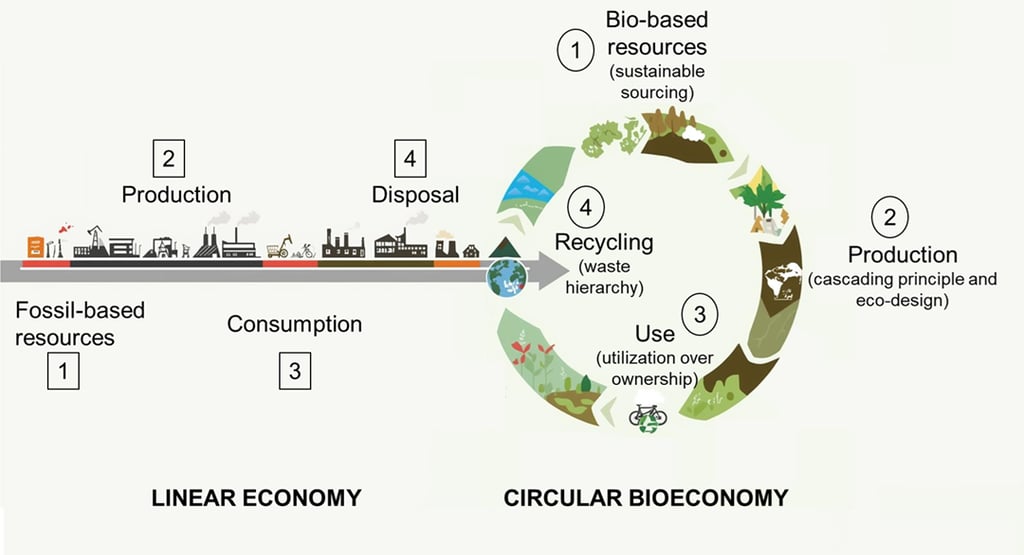
Traditionally, the linear economy follows a straightforward path marked by four stages—each represented in our visual guide with squares:
Fossil-based Resources: Extraction of finite materials like oil, coal, and gas.
Production: Manufacturing processes that often ignore long-term environmental costs.
Consumption: Products are bought, used briefly, and discarded.
Disposal: End-of-life typically means landfill or incineration, with little recovery.
This “take-make-dispose” model has dominated industrial systems for decades. But it’s increasingly unsustainable: over 90% of extracted materials are wasted after a single use, and global waste is projected to rise by 70% by 2050Reconomy.
The Circular Bioeconomy: Regenerate, Reuse, Reimagine
In contrast, the circular bioeconomy is a regenerative model that prioritizes sustainability and resource efficiency. In our infographic, its stages are marked with circles to emphasize continuity:
Bio-based Resources (Sustainable Sourcing): Materials are derived from renewable sources like plants, algae, and agricultural waste.
Production (Cascading Principle & Eco-design): Products are designed for longevity, modularity, and minimal environmental impact.
Use (Utilization over Ownership): Sharing, leasing, and repair replace single-use consumption.
Recycling (Waste Hierarchy): Materials are recovered, reused, or composted—minimizing landfill and maximizing value.
This model not only reduces environmental harm but also fosters innovation, resilience, and long-term profitability.
Why This Matters for Design and Innovation
At our firm, we champion the Safe and Sustainable by Design (SSbD) approach. This means integrating safety, circularity, and sustainability from the earliest design phases—not as an afterthought. Whether you're developing infrastructure, consumer products, or industrial systems, embracing circular bioeconomy principles can:
Reduce dependency on volatile fossil markets
Lower carbon footprints and waste
Unlock new business models like product-as-a-service
Align with evolving regulations and consumer expectations
Visualizing the Shift
Our blog image captures this contrast: the linear economy flows in a rigid, wasteful line, while the circular bioeconomy loops gracefully—symbolizing renewal and efficiency. Squares vs. circles. Extraction vs. regeneration. Waste vs. value.
Ready to transition from linear to circular? Our team of sustainability engineers is here to guide your organization toward smarter, safer, and more sustainable design strategies. Let’s build a future where resources flow—not fade.