
ESG and Emissions Scopes: What Companies Get Wrong—and What Actually Matters
ESG metrics only matter when they inform real decisions. Why Scope 1, 2, and 3 emissions are tools for strategy—not just reporting.
1/30/20263 min read
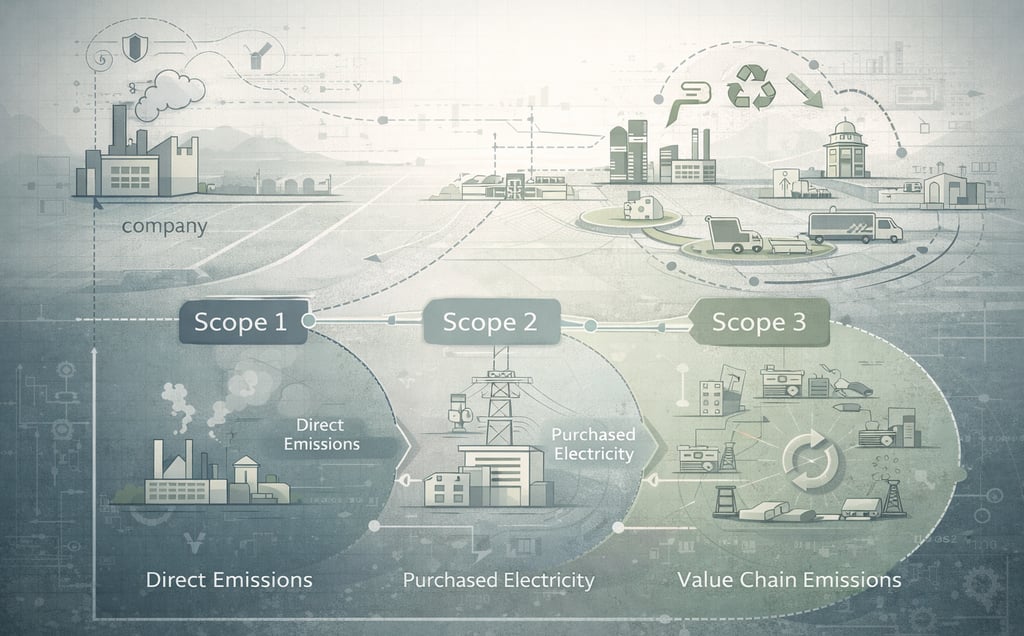
Environmental, Social, and Governance (ESG) has become a central language of sustainability in boardrooms, investor meetings, and regulatory discussions. Yet despite its widespread adoption, ESG is often misunderstood, poorly implemented, or reduced to a reporting exercise detached from real business decisions.
Nowhere is this more evident than in how organizations approach emissions scopes—Scope 1, 2, and 3. These indicators are widely referenced, but rarely used effectively to guide strategy, design, and investment.
Understanding ESG—and using scope indicators correctly—is not about ticking boxes. It is about building decision-ready systems that stand up to scrutiny and create long-term value.
ESG: A Framework, Not a Strategy
ESG is best understood as a lens, not a strategy in itself.
Environmental factors assess how a company interacts with natural systems
Social factors examine impacts on workers, communities, and customers
Governance evaluates how decisions are made, controlled, and enforced
ESG does not tell an organization what to do. It tells stakeholders how well an organization manages risk, opportunity, and responsibility across these dimensions.
The problem arises when ESG is treated as:
A branding exercise
A reporting obligation
A set of disconnected KPIs
In reality, ESG only becomes meaningful when it is anchored in operations, design choices, and governance structures.
Emissions Scopes: The Backbone of the “E” in ESG
Greenhouse gas (GHG) emissions reporting is one of the most mature—and most misunderstood—elements of ESG. The widely used Scope 1, 2, and 3 classification provides a structured way to understand where emissions occur across the value chain.
Scope 1: Direct Emissions
Scope 1 covers direct emissions from sources that an organization owns or controls, such as:
Combustion in boilers, furnaces, or vehicles
On-site industrial processes
These emissions are usually the easiest to measure and control. However, for many companies—especially in services, manufacturing, and consumer goods—Scope 1 represents only a small fraction of total climate impact.
Scope 2: Indirect Energy Emissions
Scope 2 includes indirect emissions from purchased energy, primarily electricity, heat, or steam.
While still relatively straightforward to quantify, Scope 2 already introduces complexity:
Market-based vs. location-based accounting
Energy contracts, guarantees of origin, and renewable sourcing
Decisions here are not just technical—they are strategic, involving procurement, risk exposure, and credibility.
Scope 3: Value Chain Emissions
Scope 3 covers all other indirect emissions across the value chain, both upstream and downstream, including:
Raw material extraction
Supplier manufacturing
Logistics and distribution
Product use
End-of-life treatment
For most organizations, Scope 3 accounts for 70–95% of total emissions.
This is also where most ESG efforts break down.
Why Scope 3 Is Where ESG Becomes Real—or Fails
Scope 3 emissions are difficult not because they are optional, but because they challenge how companies think about control, influence, and responsibility.
Common mistakes include:
Treating Scope 3 as “out of scope” because it sits outside direct control
Delaying action while waiting for perfect supplier data
Reporting high-level estimates without linking them to decisions
Yet Scope 3 is where:
Design choices lock in future emissions
Circularity strategies deliver or fail to deliver value
Bioeconomy pathways rise or collapse
Regulatory and reputational risks accumulate
Addressing Scope 3 effectively requires life cycle thinking, not just carbon accounting.
From Reporting to Decision Support
The purpose of scope indicators is not disclosure alone—it is decision support.
Used correctly, Scope 1–3 data helps organizations:
Identify real emissions hotspots
Prioritize interventions with the highest leverage
Avoid burden shifting across the value chain
Align sustainability goals with innovation and procurement
This is where tools such as Life Cycle Assessment (LCA), portfolio sustainability assessments, and SSbD frameworks become essential. They transform emissions data from static numbers into actionable insights.
ESG, Circularity, and Safe & Sustainable by Design
Emissions scopes cannot be separated from how products and systems are designed.
Circular economy strategies—material substitution, reuse, modularity, extended lifetimes—directly influence Scope 3 emissions.
Bioeconomy solutions reshape upstream emissions profiles while introducing new safety, land-use, and social considerations.
Safe & Sustainable by Design (SSbD) ensures that climate benefits do not come at the expense of toxicity, safety, or long-term regulatory risk.
Without integration, organizations risk:
Reducing Scope 1 and 2 while increasing Scope 3
Optimizing carbon at the expense of other environmental or social impacts
Creating stranded assets under future regulation
Governance Is the Missing Link
Strong ESG performance depends less on dashboards and more on governance.
Clear roles, escalation mechanisms, decision criteria, and accountability structures ensure that:
Scope data is trusted
Trade-offs are explicit
Sustainability considerations are applied early—when they matter most
ISO standards, when used correctly, can support this governance—not as compliance checklists, but as operating systems for consistency and learning.
A More Mature ESG Conversation
The next phase of ESG maturity will not be defined by who reports the most indicators—but by who uses them to make better decisions under uncertainty.
Scope 1, 2, and 3 are not just reporting categories.
They are signals—pointing to where value, risk, and responsibility truly sit.
Organizations that understand this move beyond compliance.
They build resilience, credibility, and long-term competitiveness.