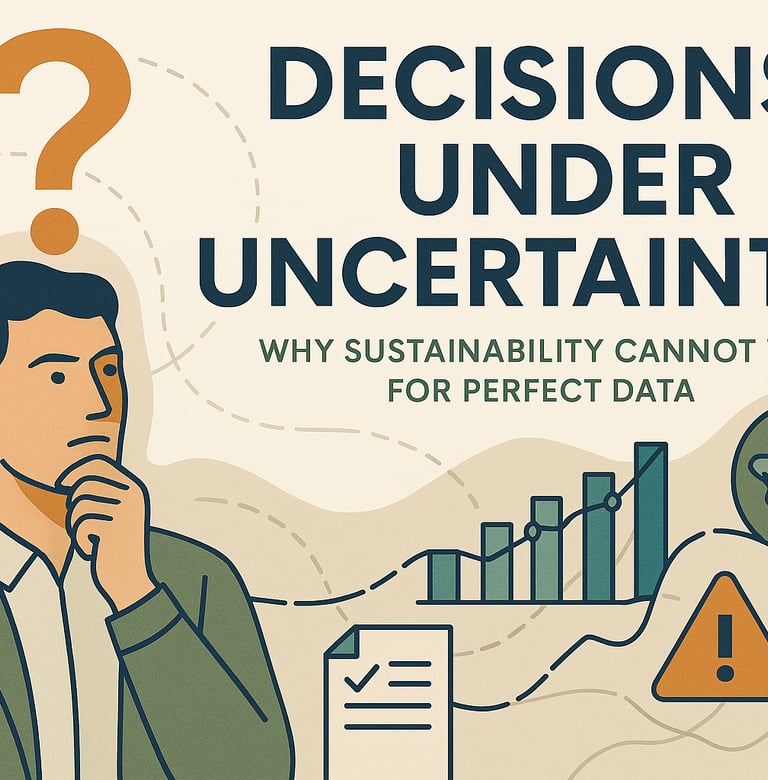
Decisions Under Uncertainty: Why Sustainability Cannot Wait for Perfect Data
Why waiting for certainty delays the decisions that matter most
2/9/20262 min read
Sustainability decisions are increasingly delayed in the name of rigor.
More data is requested. Models are refined. Assumptions are debated. Sensitivity analyses multiply. And while this pursuit of precision may appear responsible, it often produces the opposite effect: inaction at the moment when direction matters most.
The uncomfortable truth is this:
uncertainty is not a temporary problem in sustainability — it is a structural condition.
And strategies that wait for perfect data rarely survive reality.
Uncertainty Is Structural, Not a Phase
In complex systems — energy, materials, chemicals, bioeconomy, infrastructure — uncertainty does not disappear with time. It simply changes form.
Sources of uncertainty include:
evolving regulation and policy signals
immature or rapidly changing technologies
incomplete supply chain visibility
future behavior of markets, users, and ecosystems
Expecting sustainability decisions to wait until all variables are known is equivalent to deciding not to decide.
Organizations that treat uncertainty as a flaw to be eliminated consistently fall behind those that treat it as a condition to be managed.
Early Decisions Shape Most Outcomes
By the time detailed sustainability data is available, most outcomes are already locked in.
Material choices, process configurations, sourcing models, and product architectures made at early design stages typically determine 70–90% of environmental and social impacts — long before precise LCA results or verified ESG metrics exist.
Late-stage precision cannot undo early-stage direction.
This is why sustainability efforts that focus exclusively on downstream measurement often feel technically robust but strategically weak.
Precision vs Leverage
There is a fundamental imbalance in many sustainability programs:
High effort is invested in refining late-stage metrics
Little attention is paid to early-stage decision leverage
Perfect data applied too late has limited power.
Imperfect insight applied early can shape entire systems.
The role of sustainability tools, therefore, is not to eliminate uncertainty — but to guide direction under uncertainty.
Life Cycle Thinking Without Paralysis
Life cycle thinking is often misunderstood as synonymous with detailed life cycle assessment.
In reality, its most powerful application is qualitative and directional:
identifying where impacts are likely to concentrate
revealing trade-offs between materials, energy, and use phases
flagging design choices that are difficult to reverse
Used this way, life cycle thinking becomes a strategic filter, not a reporting exercise.
It allows organizations to ask better questions early — even when numbers are rough.
SSbD: Acting Responsibly Before Certainty Exists
Safe and Sustainable by Design (SSbD) is particularly valuable in uncertain contexts.
Not because it provides answers, but because it provides discipline.
SSbD:
integrates safety, sustainability, and functionality early
forces explicit assumptions instead of implicit ones
documents decision logic so it can evolve as data improves
reduces the risk of late-stage redesign driven by overlooked constraints
SSbD does not eliminate uncertainty.
It makes decisions under uncertainty defensible.
Governance That Allows Imperfect Decisions
The real blocker to acting under uncertainty is rarely technical — it is governance.
Organizations stall when they lack:
clear escalation paths for trade-offs
agreed thresholds for “good enough” information
accountability for directional decisions
tolerance for learning and course correction
Effective sustainability governance does not demand perfection.
It defines who decides, when, and based on what level of confidence.
From Data Obsession to Decision Capability
The organizations that lead in sustainability are not those with the most refined models — but those with the strongest decision capability.
Capability to:
act with incomplete information
revise decisions without reputational panic
integrate sustainability into design and procurement
move forward while others wait
A final thought:
The most damaging sustainability decision is not the wrong one — it’s the one postponed.