
Decarbonisation Without Illusions: Why Strategy Fails When Physics, Design, and Governance Are Ignored
Decarbonisation fails when ambition outruns design and governance. Why physics, life-cycle thinking, and decision discipline matter more than targets.
2/2/20263 min read
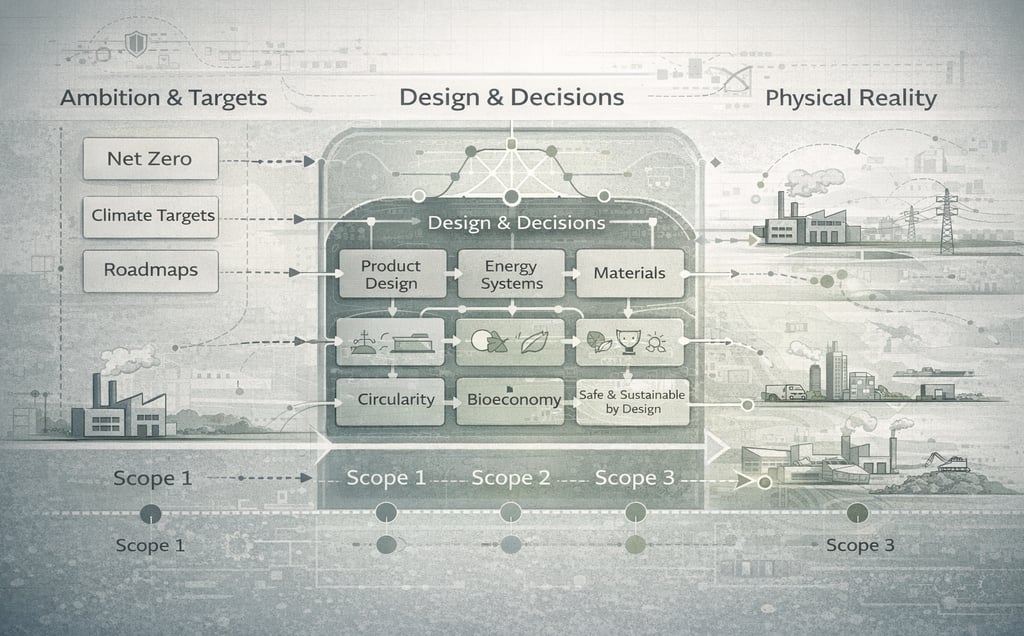
Decarbonisation has become one of the most widely used—and least clearly understood—terms in sustainability.
Companies publish roadmaps, announce net-zero targets, and commit to long-term reductions. Yet behind many of these commitments lies a fragile reality: decarbonisation strategies that rely more on accounting mechanisms than on changes to how products, systems, and decisions are actually designed.
Decarbonisation only works when it confronts physical constraints, system design, and governance—not when it is treated as a reporting exercise.
Decarbonisation Is Not Carbon Accounting
Carbon accounting is necessary.
Decarbonisation is something else entirely.
Accounting tells us where emissions occur.
Decarbonisation requires us to change why they occur.
This distinction matters because many organizations:
Optimize Scope 1 and 2 emissions while locking in Scope 3 impacts
Rely on offsets before addressing structural drivers
Announce long-term targets without short-term decision rules
Real decarbonisation starts upstream—long before emissions appear on a balance sheet.
The Physics of Decarbonisation
There is no decarbonisation strategy that escapes physics.
Energy density, material properties, thermodynamics, and land constraints define what is possible. This is particularly evident in:
Industrial heat and process emissions
Transport and logistics
Bio-based and circular material systems
In Europe, regulatory pressure often runs ahead of infrastructure readiness.
In Latin America, resource availability can exceed institutional capacity to deploy it sustainably.
Ignoring these constraints leads to strategies that look coherent on paper but collapse in implementation.
Design Choices Lock in Carbon
Most emissions are determined before a product or system exists—during design.
Key design decisions that lock in carbon include:
Material selection and sourcing
Product lifetime and repairability
Energy intensity during use
End-of-life pathways
This is why Safe and Sustainable by Design (SSbD) is central to credible decarbonisation. SSbD forces organizations to address climate, safety, regulatory, and performance considerations at the same time—reducing the risk of future rework or stranded assets.
Scope 3: Where Decarbonisation Becomes Strategic—or Fails
For most organizations, the majority of emissions sit outside direct control.
Scope 3 is often described as “hard to address.”
In reality, it is where influence, design, and leverage sit.
Decarbonisation fails when organizations:
Treat Scope 3 as a data problem instead of a design problem
Wait for suppliers to act without changing specifications
Focus on reporting accuracy instead of directional decisions
Life cycle thinking transforms Scope 3 from a burden into a strategic lens—revealing where small design shifts can unlock large emissions reductions.
Circularity and Decarbonisation Are Not Synonyms
Circular economy strategies are frequently presented as inherently decarbonising. This is not always true.
Circular systems:
Can reduce material demand and upstream emissions
Can also increase energy use, logistics, or complexity
Without life cycle assessment and system-level thinking, circularity can shift emissions rather than reduce them.
Effective decarbonisation requires understanding when circular solutions reduce total impact—and when they do not.
Governance: The Quiet Determinant of Success
Behind successful decarbonisation efforts lies a less visible factor: governance.
Decarbonisation succeeds when organizations define:
Clear decision criteria under uncertainty
Escalation paths for trade-offs
Accountability across functions
Consistent rules for investment and design
ISO systems, when used properly, can support this governance—not as compliance tools, but as decision infrastructures that enable learning and consistency.
From Targets to Trajectories
Net-zero targets are not strategies.
Trajectories are.
A credible decarbonisation pathway is defined by:
Sequenced decisions
Design rules applied early
Investment aligned with physical reality
Flexibility to adapt as technology and regulation evolve
This is especially important for organizations operating across Europe and Latin America, where decarbonisation pathways must navigate different regulatory speeds, infrastructures, and market dynamics.
Decarbonisation as a Capability
The organizations that will lead the next phase of decarbonisation are not those with the boldest announcements—but those that build capability.
Capability to:
Make decisions with incomplete data
Integrate climate into design and procurement
Align circularity, bioeconomy, and SSbD coherently
Translate ambition into operational reality
At Abaeco Consultants, we support organizations in building this capability—helping them move from decarbonisation intent to decarbonisation performance.
A Final Thought
Decarbonisation is not a destination.
It is a discipline.
One that requires humility toward physics, rigor in design, and maturity in governance.
If your organization is navigating complex decarbonisation decisions—across value chains, regions, or technologies—we invite you to a free consultation.
Because the hardest part of decarbonisation is not setting the target.
It is designing the path that actually gets you there.