Circular Economy Without Governance Is Just Expensive Recycling
Circularity doesn’t fail for lack of ideas—only for lack of ownership. Without governance, every loop breaks before it begins.
2/16/20263 min read
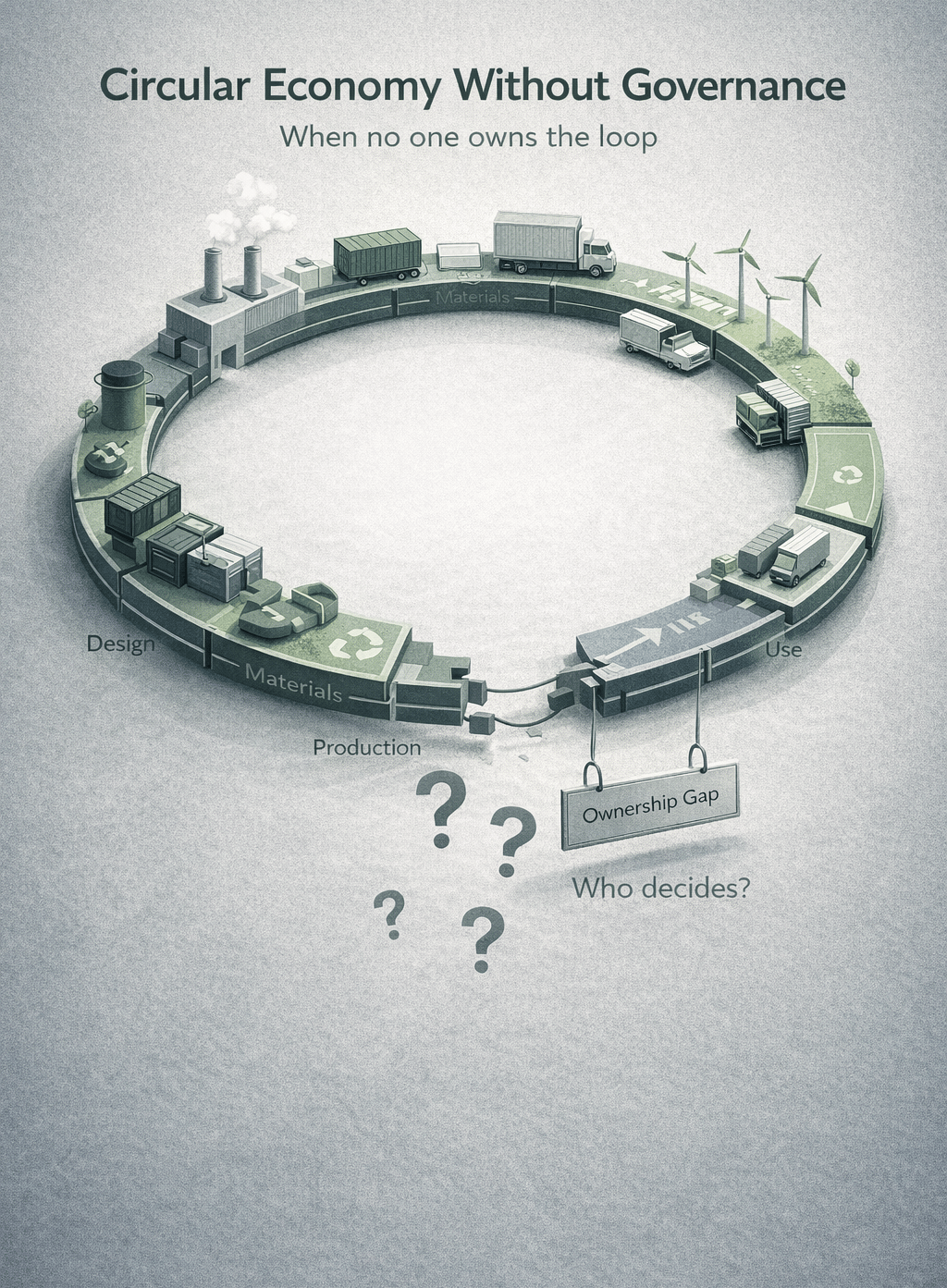
Circularity doesn’t fail because it’s wrong.
It fails because no one decides who owns the loop.
The circular economy has become one of the most widely embraced ideas in sustainability. Across Europe and Latin America, organizations invest in pilots, launch circular initiatives, and report improvements in recycling rates, recycled content, or waste diversion.
Yet many of these efforts stall, remain marginal, or quietly disappear after the pilot phase.
The problem is not circularity.
The problem is governance.
Without decision discipline, circular economy initiatives collapse into cost centers rather than value-creating systems.
Circularity Is Easy to Announce—and Hard to Operate
Circularity is attractive because it promises multiple benefits at once:
• reduced resource use
• lower emissions
• improved resilience
• new business models
But circular systems are operationally demanding. They require coordination across functions and across the value chain—often beyond the organization’s direct control.
When governance is weak, circularity defaults to what is easiest to measure and communicate:
recycling rates.
Recycling is not circular economy.
It is a waste-management activity at the end of a failed system.
Pilots Without Pathways
A recurring pattern appears across industries:
• a circular pilot proves technical feasibility
• a business case is declared “promising”
• scaling stalls due to cost, complexity, or unclear ownership
Pilots fail to scale not because the concept is wrong, but because no one answers the hard questions:
• Who owns the circular loop?
• Who pays for reverse logistics?
• Who carries risk when material quality varies?
• Which function decides when circularity overrides short-term cost?
Without explicit answers, circular initiatives remain experimental—and expendable.
Circular KPIs Without Accountability
Many organizations adopt circular KPIs:
• recycled content percentage
• waste diversion rates
• material recovery targets
These indicators look reassuring.
They rarely guide decisions.
When KPIs are disconnected from authority:
• procurement optimizes cost
• design prioritizes performance or speed
• operations minimize disruption
Circular targets exist—but no one is accountable for trade-offs.
This is how circularity becomes symbolic: measured, reported, and celebrated—yet rarely decisive.
Design Choices Quietly Kill Circular Value
Most circular value is lost long before waste is generated.
Design decisions determine:
• material compatibility
• disassembly feasibility
• contamination risk
• economic recoverability
When design teams are not accountable for downstream circular performance, recovery systems inherit constraints they cannot overcome.
This is where Safe and Sustainable by Design (SSbD) matters.
SSbD forces circularity upstream—into product architecture, material selection, and system configuration.
But SSbD only works when governance allows it to influence design decisions early.
Europe and Latin America: Different Contexts, Same Trap
In Europe, circular economy efforts often collapse under regulatory and administrative complexity:
• ambitious targets
• fragmented responsibility
• misaligned incentives across functions
In Latin America, circular initiatives frequently struggle with:
• infrastructure limitations
• informal value chains
• imported circular models that ignore local conditions
In both cases, the failure mode is identical:
circularity is added to the system, not designed into it.
Circularity Is a System, Not a Program
Organizations that succeed with circular economy treat it as operating infrastructure, not as a sustainability initiative.
They:
• assign ownership for circular loops
• embed circular criteria into design and procurement
• align KPIs with decision rights
• design reverse logistics and material flows intentionally
• use life cycle thinking to identify real leverage points
Circularity becomes durable when it is governed—when decisions are traceable, responsibilities are explicit, and trade-offs are resolved systematically.
The Real Cost of Ungoverned Circularity
Circularity without governance is not neutral.
It is expensive.
It creates:
• stranded pilots
• inefficient logistics
• quality failures
• internal frustration
• reputational risk
Most importantly, it erodes trust in circular economy itself—leading organizations to dismiss it as impractical when the real issue was execution.
A Final Thought
Circular economy is not a moral stance.
It is a design and governance challenge.
Circularity doesn’t scale because systems don’t decide who owns the loop.
The organizations that lead in circular economy will not be those with the most pilots—but those with the discipline to turn circular ambition into operational reality.
At Abaeco Consultants, we help organizations in Europe and Latin America move beyond symbolic circularity—designing systems where circular value is technically viable, economically grounded, and governed for scale.
Because without governance, circularity is just expensive recycling.