
Circular Economy Fails Where Product Design Ignores the System
Circularity is not created by recycling infrastructure. It is determined much earlier—when products, materials, and systems are designed.
3/11/20263 min read
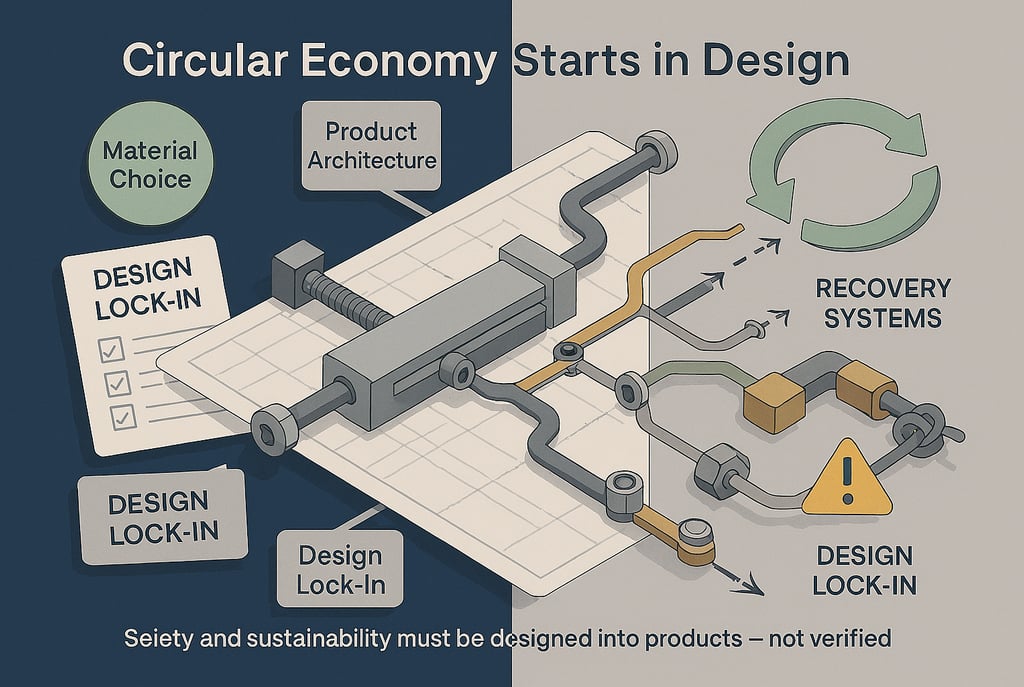
Circularity Is Often Treated as an End-of-Life Problem
When organizations talk about the circular economy, the conversation usually starts with recycling, waste management, or reverse logistics.
These elements matter.
But they rarely determine whether circularity actually works.
The real success or failure of circular systems is decided much earlier—during product design.
By the time a product reaches the market, its circular potential has already been largely determined by decisions about:
materials
product architecture
manufacturing methods
assembly choices
compatibility with recovery systems
In many cases, the circular economy fails not because recycling systems are weak, but because products were never designed to be recovered in the first place.
Design Lock-In: The Hidden Barrier to Circularity
One of the most overlooked barriers to circularity is design lock-in.
During product development, design teams make decisions that shape the entire life cycle of a product. These decisions include:
material combinations
bonding and fastening methods
component integration
coatings and additives
tolerances and durability requirements
Once these choices are finalized, they are extremely difficult—and often economically impossible—to reverse.
For example:
multi-material composites may improve performance but make separation impossible
permanent adhesives can prevent disassembly
incompatible polymers can destroy recycling value streams
complex product architectures can make repair economically unfeasible
From a design perspective, these choices may be logical.
From a circular perspective, they may quietly eliminate any realistic recovery pathway.
Circularity fails here—not in waste management facilities, but in early design decisions.
Material Compatibility Determines Circular Potential
Circular systems depend on material compatibility.
Recycling, remanufacturing, and recovery systems operate within specific technical and economic constraints. If products fall outside those constraints, recovery becomes difficult or impossible.
Common design issues include:
incompatible polymer blends that cannot be separated
additives that contaminate recycling streams
coatings that prevent material recovery
mixed metals that require expensive separation processes
These challenges are not primarily waste management problems. They are design problems.
If materials are selected without considering downstream recovery systems, the result is predictable:
materials that technically could be recycled—but never are.
Recovery Economics: Circularity Must Make Financial Sense
Even when technical recycling is possible, economics determine whether circularity happens in practice.
Recovery systems require:
collection infrastructure
sorting processes
material separation
reprocessing technology
market demand for recovered materials
If product design increases recovery costs beyond the value of the recovered material, the system will not function.
This is why some products that are technically recyclable still end up in landfill or incineration.
Design choices can either support recovery economics—or quietly destroy them.
Examples include:
products that require manual disassembly
materials with low recycling yield
contamination risks that reduce material quality
complex assemblies that increase processing costs
Circularity must work not only technically, but economically.
And that economics is shaped long before a product enters the waste system.
Circular Systems Require Design Thinking at the System Level
A truly circular approach requires designers to think beyond the product itself.
It requires thinking about the entire system the product will move through:
manufacturing systems
logistics networks
user behavior
repair ecosystems
recovery infrastructure
material markets
When design decisions ignore this system context, circular strategies become fragile.
Recycling programs struggle.
Recovery economics fail.
Circular ambitions remain theoretical.
The product may perform perfectly—but it does not fit the system required to keep materials in circulation.
Circular Economy Must Start in Product Development
Organizations that successfully implement circularity treat it as a design challenge, not a waste management challenge.
They embed circular thinking directly into product development by:
evaluating material compatibility early
designing for disassembly and repair
aligning materials with existing recovery systems
testing recovery pathways before commercialization
integrating life-cycle thinking into design decisions
This approach shifts circularity upstream—where it can still influence outcomes.
When circular considerations arrive too late, they become constraints rather than design opportunities.
From Recycling Strategy to Design Strategy
The circular economy cannot be built solely through better recycling infrastructure.
It must be built through better product design.
Design determines:
whether materials can be recovered
whether products can be repaired or refurbished
whether recycling is economically viable
whether circular systems can scale
Without design integration, circular strategies remain dependent on downstream fixes that rarely succeed.
A Final Thought
Most circular strategies fail long before a product reaches the market.
They fail in the design phase.
Circularity is not something that happens after a product is used.
It is something that must be designed into the product and the system from the beginning.
At Abaeco Consultants, we support organizations in embedding circularity directly into product development, material selection, and system design—ensuring that circular ambitions translate into solutions that are technically viable and economically scalable.
Because in the circular economy, design decides what recovery systems can achieve.