Case Study: Engineering a Circular and Safe-by-Design Biogas Concept for an Agri-Food System
An engineering-led case study on designing circular bioenergy solutions with safety and sustainability embedded from the start. From feasibility to decision-ready insights for agri-food systems.
1/8/20262 min read
Background
Agri-food and livestock operations generate large volumes of organic residues that are often underutilized or managed as a cost rather than a resource. At the same time, farms and cooperatives face rising energy prices, tighter environmental regulation, and increasing pressure to demonstrate sustainability performance.
The challenge is not identifying ideas — but determining which circular solutions are technically viable, safe, and economically realistic.
The Challenge
A livestock-based agri-food system sought to evaluate whether anaerobic digestion (AD) could be used to:
Valorize slurry and organic residues
Generate renewable biogas
Reduce emissions and environmental impact
Align with circular economy and safety principles
Key constraints included:
Limited capital availability
Existing infrastructure not designed for biogas recovery
Safety and operational risks associated with gas handling
Uncertainty about regulatory and environmental performance
The core question was clear:
Is this a sound circular investment — and if so, how should it be designed from the start?
Engineering Approach
Rather than starting with technology selection, the analysis followed a circular and Safe-by-Design logic.
1. System-level circular assessment
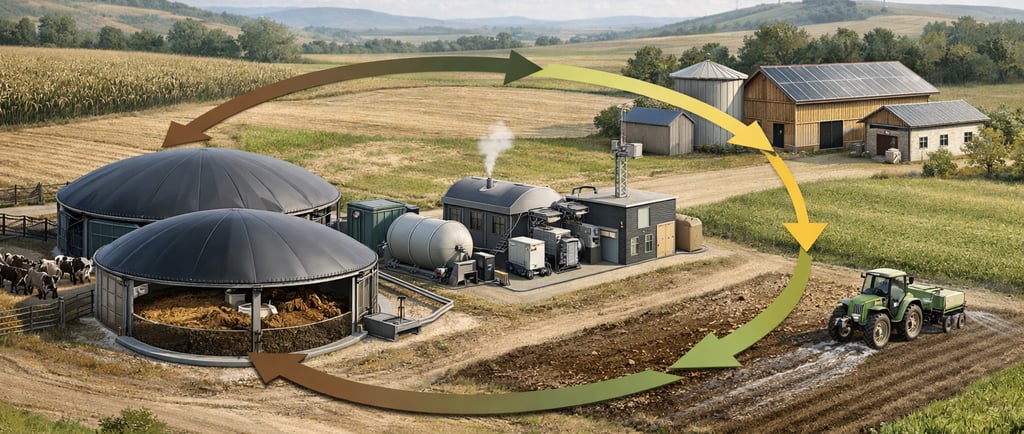
The first step was mapping material and energy flows across the farm system, identifying where value was lost and where circular loops could realistically be closed.
This included:
Slurry generation and storage
Existing waste management practices
Energy demand and potential biogas use
2. Circular design option: covered slurry tanks
Instead of proposing a conventional standalone digester, an alternative circular solution was evaluated:
earth-lined slurry tanks retrofitted as covered lagoons for biogas harvesting.
This option:
Reused existing infrastructure
Reduced capital expenditure
Enabled gradual transition toward circular energy recovery
3. Safe and Sustainable by Design (SSbD) screening
Safety and sustainability considerations were integrated from the earliest design stage, including:
Gas containment and leak prevention
Operational safety for farm personnel
Environmental risk reduction
Long-term system robustness
Rather than treating safety as a downstream requirement, it was embedded in the concept selection itself.
4. Feasibility and decision support
The concept was evaluated from a:
Technical feasibility perspective
Environmental performance standpoint
High-level economic and risk perspective
The outcome was not a theoretical model, but a decision-oriented recommendation.
Results and Insights
The study demonstrated that:
Circular bioenergy solutions can be implemented incrementally, without full system replacement
Reusing existing assets significantly improves feasibility
Early SSbD integration reduces both safety risks and long-term redesign costs
Engineering-driven sustainability assessments provide clearer investment signals than high-level ESG metrics
Most importantly, the client gained a clear go / no-go pathway and a technically sound basis for next steps.
Why This Case Matters
Many circular economy initiatives fail because they focus on aspiration before engineering. Without early feasibility, safety integration, and system-level thinking, projects often stall or underperform.
This case shows how engineering, circularity, and SSbD can be combined into a single decision framework, enabling organizations to move forward with confidence.
How Abaeco Consultants Supports Similar Projects
We help agri-food producers, cooperatives, and process industries evaluate circular and low-carbon opportunities through engineering-led feasibility studies that:
Reduce technical and investment risk
Integrate safety and sustainability from day one
Translate complexity into clear, actionable decisions
If you are exploring biogas, agrivoltaics, waste-to-value, or circular process upgrades, we can help you assess what works — and what doesn’t — before capital is committed.
👉 Get in touch to discuss your project.