
Agrivoltaics Beyond the Hype: What Cherries, Berries, and Data Tell Us About Dual-Use Land Systems
Energy and agriculture don’t have to compete for land. What agrivoltaics gets right—and where it often fails.
1/21/20263 min read
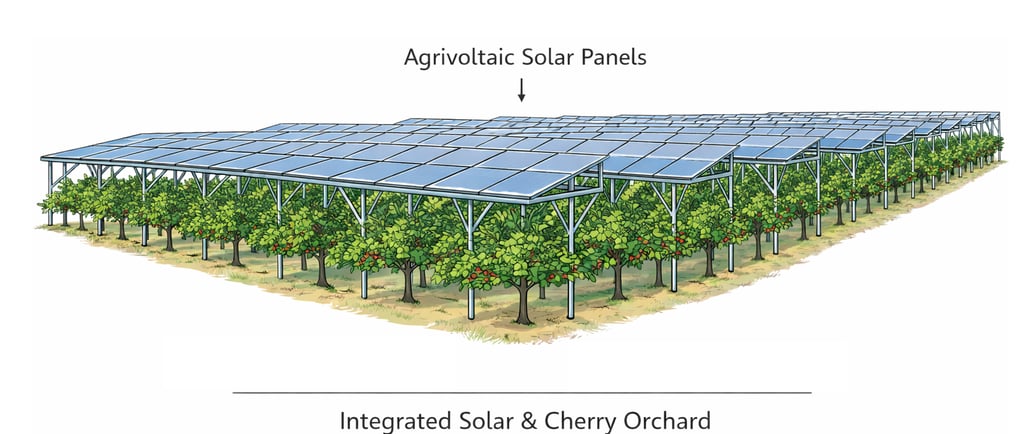
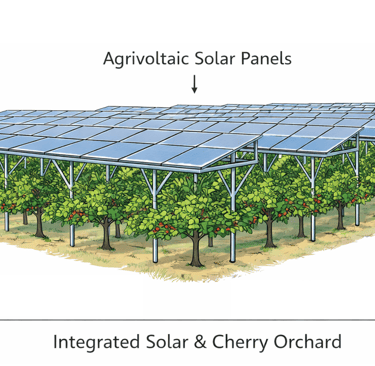
Agriculture and energy are often framed as competitors for land.
Agrivoltaics challenges that assumption.
By co-locating photovoltaic systems with agricultural production, agrivoltaics offers a dual-use land strategy—one that is increasingly relevant as food security, climate resilience, and energy transition pressures converge.
But beyond the concept, the real question for decision-makers is simple:
Does it work—in practice, economically and agronomically?
What Is Agrivoltaics—Really?
Agrivoltaics is not just about installing solar panels above crops.
Done properly, it is a system-level design challenge that requires:
Understanding crop physiology and light sensitivity
Designing panel spacing, height, and orientation
Managing microclimates (temperature, evapotranspiration, frost risk)
Aligning agricultural operations with energy infrastructure
This is where agrivoltaics moves from an engineering curiosity to a strategic land-use solution.
Why Cherries and Berries Matter
High-value perennial crops such as cherries and berries are particularly interesting in agrivoltaic systems.
These crops:
Are sensitive to heat stress, hail, and extreme weather
Benefit from partial shading under certain conditions
Require protection that is already commonly provided by netting or structures
Replacing or integrating those protective structures with photovoltaic systems can:
Reduce climate-related yield losses
Improve water efficiency by lowering evapotranspiration
Add a stable secondary revenue stream
For growers facing increasing climate volatility, agrivoltaics becomes less about energy—and more about risk management.
What the Financial Data Actually Shows
A common misconception is that agrivoltaics is only marginally profitable, or that agriculture remains the dominant revenue stream.
Financial data from multiple agrivoltaic farms suggests otherwise.
Adapted from Al Mamun et al. (2022), the figures below illustrate the relative contribution of solar electricity versus agricultural production:
India – Vegetables
Solar revenue: ~US$155,000/ha/year
Agricultural revenue: ~US$3,500/ha/year
→ Solar accounts for ~98% of total revenueIndia – Grapes
Solar revenue: ~US$51,000/ha/year
Agricultural revenue: ~US$3,500/ha/year
→ Solar accounts for ~94% of total revenueUSA – Lettuce
Solar revenue: ~US$80,000/ha/year
Agricultural revenue: ~US$17,000/ha/year
→ Solar accounts for ~83% of total revenueGermany – Potatoes
Solar revenue: ~US$71,000/ha/year
Agricultural revenue: ~US$12,800/ha/year
→ Solar accounts for ~85% of total revenue
The message is not that agriculture becomes irrelevant.
It is that land productivity fundamentally changes when energy generation is added.
For high-value crops like cherries and berries, where agricultural revenues are already higher than staple crops, the combined system can significantly improve overall land economics—if designed correctly.
The Design Trap: When Agrivoltaics Fails
Agrivoltaics is not automatically sustainable or circular.
Poorly designed systems can:
Reduce yields due to excessive shading
Disrupt farm operations and logistics
Lock in inflexible infrastructure for decades
Create conflicts between energy and agricultural priorities
This is why agrivoltaics must be approached through life cycle thinking and Safe & Sustainable by Design (SSbD) principles.
Key questions include:
At what life stage does the system deliver the most value?
Where are environmental or safety trade-offs introduced?
How reversible or adaptable is the infrastructure?
Who controls decisions over the system’s lifetime?
Agrivoltaics as a Circular, Resilient System
When designed with intention, agrivoltaic systems can contribute to:
Climate adaptation in agriculture
Decentralized renewable energy generation
Improved water and land-use efficiency
Long-term revenue stability for rural communities
For perennial fruit systems like cherries and berries, agrivoltaics can become part of a circular bioeconomy strategy—linking energy, food, land stewardship, and resilience.
From Concept to Decision-Ready
The future of agrivoltaics will not be defined by demonstration projects alone, but by decision discipline:
Robust feasibility assessments
Crop-specific design criteria
Clear governance between energy and agricultural stakeholders
Data-driven performance monitoring over time
At Abaeco Consultants, we see agrivoltaics not as a standalone solution, but as a system design challenge—one that sits at the intersection of engineering, agriculture, sustainability, and policy.
A Final Thought
Agrivoltaics forces a reframing of the land-use debate.
The question is no longer “energy or agriculture?”
It is “how do we design systems that deliver both—without compromising either?”
If you are exploring agrivoltaics for high-value crops such as cherries or berries, or assessing its role within a broader sustainability or circularity strategy, we invite you to a free consultation.
Not a pitch—just a structured discussion about feasibility, risks, and real-world performance.
Sustainable systems succeed when they are designed for reality, not headlines.