
A structured approach for complex bio-based systems
Bridging safety, sustainability, and circularity in complex bio-based process systems
1/23/20261 min read
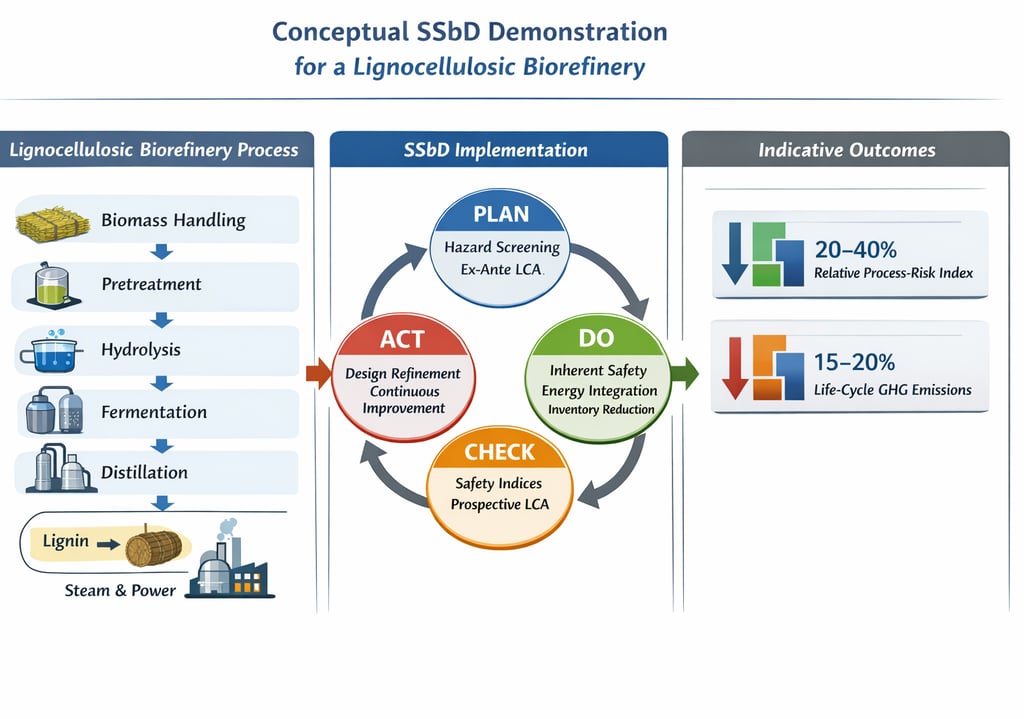
In our recent research, we developed a biorefinery-specific SSbD framework that connects safety, sustainability, and operational reliability within a single, coherent structure. The key idea is simple: SSbD should function as a continuous improvement system, not a one-off assessment.
The framework is built around:
a Plan–Do–Check–Act (PDCA) cycle to support iterative learning,
early integration of hazard identification, inherent safety, and life-cycle thinking, and
the use of established tools such as process safety analysis, life-cycle assessment, and techno-economic indicators to guide design trade-offs.
Rather than replacing existing methods, the framework helps align them—so that decisions about safety, energy integration, material choice, or process configuration are evaluated together, not in isolation.
What this means in practice
A conceptual application to a lignocellulosic bioethanol biorefinery shows how this approach can work in real design contexts. By addressing safety and sustainability hotspots early—such as flammable inventories, energy-intensive separations, or hazardous pretreatment steps—design teams can steer projects toward solutions that are both safer and more sustainable.
Importantly, this kind of integration does not require perfect data or detailed engineering. Even at early stages, structured screening can reveal where risks concentrate and where improvements are most effective.
Moving from frameworks to implementation
For companies and project developers, SSbD should not be seen as an additional burden, but as a strategic tool:
to reduce costly redesigns and retrofits,
to support regulatory readiness and future certification,
and to build more resilient, investable bio-based projects.
At our consultancy, we focus on translating these concepts into actionable guidance—helping organizations embed safety and sustainability into their decision-making from the very beginning.
The bioeconomy will only deliver on its promise if innovation is matched with responsibility. Safe and Sustainable by Design, when applied at the system level, offers a powerful way to make that happen.